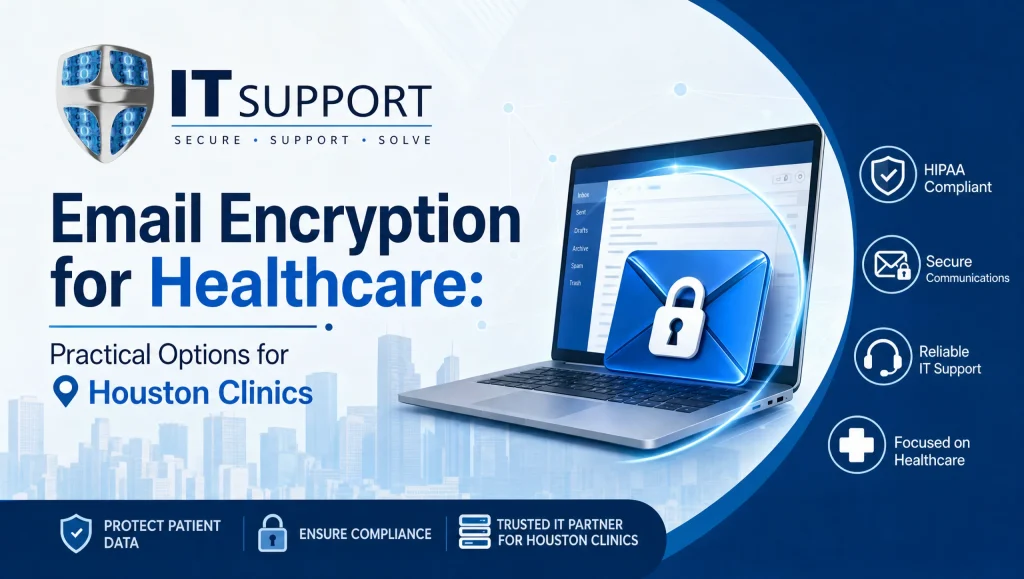
Healthcare Email Encryption Houston: Practical Options for Clinics
Protecting patient information over email is both a daily necessity and a daily risk for clinics and dental practices across Greater Houston. PHI often needs to move quickly between the front desk, providers, specialists, labs, and insurers. HIPAA expects you to secure that flow without slowing patient care. This guide breaks down healthcare email encryption Houston teams can truly use, where encrypted email fits (and where it doesn’t), and the practical steps to roll out secure messaging with minimal disruption. CompTSS is a Houston-based healthcare IT partner focused on HIPAA, dental workflows, and responsive, flat‑rate support if you want local help getting there.
In plain terms, healthcare email encryption in Houston means using policies, tools, and training so PHI sent by email is protected in transit and at rest, limited to intended recipients, and logged for HIPAA alignment—often by combining encrypted email, secure messaging portals, and strong email filtering.
Key options at a glance:
- Policy‑based email encryption gateways with DLP triggers
- Microsoft 365/Google Workspace encryption (e.g., OME, S/MIME, CSE)
- Patient portals or secure messaging platforms for PHI‑heavy exchanges
- Advanced email filtering, MFA, and least‑privilege access
- Encrypted backups and tested recovery for mailboxes and archives
What Healthcare Email Encryption Houston Really Means Under HIPAA
HIPAA doesn’t certify products; it requires reasonable and appropriate safeguards based on your risks. For email, that typically includes:
- Encrypting messages in transit (and often at rest)
- Limiting access to intended recipients
- Maintaining audit trails and retention as required
- Enforcing the minimum necessary rule
- Training your staff and reviewing controls in periodic risk assessments
HHS guidance on HIPAA and email encryption
Email vs. PHI Reality Check—When to Email, When to Use a Portal
- Use encrypted email when: You’re sending simple, time‑sensitive information or a single document to a known recipient (for example, a specialist you already coordinate with), and you can verify addresses. Policy‑based encryption or Microsoft/Google add‑ons can cover most of these scenarios effectively.
- Use a secure messaging portal when: You’re sharing multi‑document packets, imaging, or you expect ongoing back‑and‑forth with patients; you need stronger identity verification or message expiration; or you want detailed read receipts, revocation, and a clean audit trail.
The Minimum Necessary Rule and Auditability
- Minimum necessary: Configure templates and DLP rules so staff include only the required data—not full charts—when emailing.
- Auditability: Favor tools that log who sent, who opened, and when, with retention aligned to your records policy. Ensure admins and compliance teams can export reports for an audit without jumping through hoops.
Core Options Houston Clinics Can Deploy
Policy‑Based Email Encryption Gateways (subject tags, DLP triggers, TLS)
- What it is: A gateway sits in front of your mail system and enforces encryption automatically. It can trigger on keywords (like “SSN” or “DOB”), patterns (credit card or insurance IDs), or staff‑added subject tags such as [secure] or [phi].
- Why clinics like it: Minimal user friction—staff keep using Outlook or Gmail. If the recipient supports TLS, the message can deliver seamlessly; otherwise, it’s routed to a secure portal link so nothing leaks.
- Watchouts: Choose a gateway with strong DLP libraries, customizable templates, and easy branding to build patient trust. Confirm it supports message expiration and revocation for misaddressed messages.
Microsoft 365 and Google Workspace Add‑Ons (MIP/S/MIME, OME, CSE basics)
- Microsoft 365: Options include built‑in TLS, Office Message Encryption (OME), and Microsoft Information Protection (MIP) labels that can enforce encryption and “Do Not Forward.” S/MIME is strong but can be complex to manage at scale.
- Google Workspace: Offers Client‑Side Encryption (CSE) and S/MIME. CSE delivers strong protections but requires careful key management and clear processes.
- Why clinics like it: A native experience for staff, integrated with your license stack, and simpler administration if you’re already on M365 or Workspace.
- Watchouts: External recipients may face login steps or lack compatible setups. Build clear workflows for exceptions and test with your top referral partners before going live.
Patient Portals and Secure Messaging Platforms (link‑based or portal‑based delivery)
- What it is: Dedicated secure messaging with verified identities, granular access controls, and detailed audit logs. Often it’s part of your EHR or handled by a third‑party platform.
- Why clinics like it: Ideal for patient communications and PHI‑heavy exchanges. You get strong auditability and message lifecycle controls (expiration and revocation) with less guesswork.
- Watchouts: Patient friction rises if enrollment is clunky, mobile UX is weak, or password resets are frequent. Select a platform with solid mobile support and SMS/email nudges to keep things moving.
Hybrid Approach for Real‑World Workflows (front desk, referrals, imaging shares)
Most Houston practices land on a hybrid approach: policy‑based encrypted email for one‑off provider exchanges and quick documents; a secure portal for multi‑document patient packets, imaging, or ongoing threads; and clear policies describing when to use each. This mix reduces friction while meaningfully boosting PHI protection.
Tradeoffs That Matter in Daily Practice
Security Strength vs. Usability (staff clicks, patients on mobile)
Strong crypto does little if patients can’t open messages on a phone. Favor solutions with responsive mobile portals, biometric logins where supported, and concise instructions embedded in templates. A few seconds saved per message adds up for busy front desks.
Handling External Recipients (specialists, labs, insurers)
Map your top 20 external contacts across Houston, Katy, and Sugar Land. Test deliverability and the opening experience with each. Pre‑brief key partners and offer a one‑page “how to open encrypted messages” handout to reduce confusion at the start.
Message Recall, Expiration, and Revocation
Portals and some gateway tools allow revocation if a message is misaddressed. Set default expirations for sensitive content and use read receipts to verify access without over‑notifying recipients.
Deliverability, TLS Fallbacks, and Read Receipts
Ensure your solution negotiates TLS with compatible servers and falls back to portal delivery when needed. Enable read receipts that satisfy your documentation needs while avoiding disruptions for frequent partners.
Cost, Licensing, and Maintenance Fit (without quoting prices)
Consider existing M365/Workspace licenses, per‑mailbox vs. per‑domain gateway pricing, and possible add‑ons for DLP, archiving, and branding. Evaluate total cost of ownership: admin time, training, support responsiveness, and how well it fits how your staff already works.
PHI Protection Beyond Encryption: Email Filtering and Access Controls
Advanced Email Filtering and Anti‑Phishing
Most breaches start with a phish. Pair encryption with advanced email filtering that blocks credential harvesters, malware, and business email compromise attempts. Align filtering with your DLP so risky content is flagged before it leaves the domain. For deeper guidance, see our email protection best practices and DLP for email insights at https://comptss.com/email-protection-ultimate-data-loss-prevention-emai and our broader data loss prevention resources at https://comptss.com/ultimate-data-loss-prevention-encryption-backup-dlp.
MFA for Mailboxes and Admins
Enforce multi‑factor authentication for every mailbox and all admin roles. Use conditional access to step up authentication based on risk signals (new device, unfamiliar location). This is one of the highest‑impact controls you can put in place quickly.
Least Privilege, Role‑Based Access, and Logging
Limit who can configure policies, export mailboxes, or access archives. Apply role‑based access controls and log all admin actions. Review elevated rights regularly and document approvals so you’re ready for audits.
Backups and Tested Recovery for Mail and Archives
Encrypted backups with routine restore testing protect against ransomware, accidental deletions, and legal holds. Include mail, archives, and encryption keys in your recovery plan. For an overview, visit our resources on encrypted backups and tested recovery at https://comptss.com/cloud-backup-unlock-it-success-cloud-backup-sys and disaster recovery for clinics at https://comptss.com/ransomware-recovery-master-ransomware-recovery.
HIPAA‑Aligned Policies and Staff Training
Written Policies: When to Use Encryption vs. Portals
Spell out clear examples: referral letters via encrypted email; imaging and treatment plans via a secure portal; invoices without PHI via standard email. Simple rules reduce guesswork and speed up adoption.
Templates for Subject Tags and DLP Rules
Standardize subject lines such as [secure] Referral: Patient Initials + DOB (MM/YY). Configure DLP to catch SSNs, insurance IDs, and EHR‑export patterns, routing them to encryption automatically. For deeper DLP planning, see our guide to data loss prevention tools and encryption.
Training Front Desk, Billing, and Providers
Short, role‑specific training works best: 20 minutes on how to tag, when to portal, and what to do if you misaddress a message. Provide a single‑page quick reference and have staff practice on mobile devices so they know what patients experience.
Periodic Risk Assessments and Patch Hygiene
Revisit controls quarterly: update DLP dictionaries, review read‑receipt reports, and patch your mail systems, endpoints, and gateways. If you want a structured review, consider a HIPAA‑focused cybersecurity audit and zero trust assessment at https://comptss.com/cybersecurity-audit-ultimate-cybersecurity-audit or explore HIPAA compliance essentials at https://comptss.com/hipaa-compliance-unlocking-healthcare-it-hipaa.
Implementation Steps with a Houston‑Based Partner
Environment Review (M365/Google, on‑prem gateways, EDR/MFA posture)
Inventory your current licenses, mail flow, and external contacts. Verify MFA status, endpoint protection, and patch levels. Identify quick wins (such as enabling OME or refining spam filtering) and longer‑term improvements (like adopting a gateway or portal).
Pilot, Staged Rollout, and Change Management
Pilot with your front desk and one provider plus two referral partners. Measure open rates, read receipts, and patient feedback. Adjust templates, then roll out by department (billing, hygiene, specialists). Keep short weekly huddles during the first month to smooth the transition.
Ongoing Monitoring, Alerts, and Quarterly Tune‑ups
Set alerts for DLP violations, failed deliveries, and brute‑force login attempts. Review quarterly: What’s triggering encryption? Are messages bouncing? Do we need new rules for emerging document types? Small changes keep the system usable and secure.
Local Support for Dental Software and Imaging Workflows
Dental practices often share DICOM images, x‑rays, and referrals from Dentrix, Eaglesoft, Open Dental, Dexis, or Sidexis/Sirona. Make sure your encryption workflow integrates cleanly with these exports and that file sizes and formats are supported. If you need help aligning tools with clinical software, our team specializes in these platforms and the day‑to‑day realities of dental workflows.
Myth vs. Fact: HIPAA Email Basics
- Myth: “TLS alone makes us HIPAA‑compliant for email.”
Fact: TLS is necessary but not sufficient for many PHI scenarios. You also need policies, DLP triggers, access controls, and audit logs—and sometimes a portal for identity verification and message lifecycle controls. - Myth: “Encrypted email is always harder for patients.”
Fact: Well‑designed portals and policy‑based encryption can be just one extra click, especially on mobile. The keys are consistent templates, clear instructions, and testing with your most common recipient types. - Myth: “If we use a secure platform, we can skip training.”
Fact: Tools reduce risk, but staff decisions still drive outcomes. Short, role‑specific training and periodic refreshers remain essential.
From the Field: What Works in Houston Clinics
At a Houston dental group we support, the front desk struggled with encrypted messages to outside specialists. We piloted policy‑based encryption for referral letters and imaging while shifting treatment estimates to a secure portal. After a week of quick huddles and template tweaks, referral emails delivered smoothly with read receipts, and patients had fewer login issues. Staff called it “one extra click when it matters,” which is the balance most teams can live with.
How CompTSS Helps Houston Practices
CompTSS is a team of Houston IT professionals dedicated to healthcare and dentistry. We combine 24/7 monitoring with HIPAA‑focused cybersecurity, automated encrypted backups, and tested disaster recovery. Our specialists align encryption and secure messaging with your daily workflows—especially dental software like Dentrix, Eaglesoft, Open Dental, Dexis, and Sidexis/Sirona—and we provide fast remote help with on‑site support in Greater Houston, including Katy and Sugar Land.
- HIPAA‑focused cybersecurity: risk assessments, encryption policies, MFA, email filtering, and patching
- Automated, encrypted backups with disaster recovery testing
- Dental software integration and imaging workflows
- Flat‑rate Assurance plan with scalable workstation add‑ons
- Local, responsive support from a healthcare‑specialized team
If you’re evaluating your next step, start with a quick assessment. We’ll review your current mail platform, filtering, and encryption posture, then outline a right‑sized path—often a hybrid approach that’s easy for staff and strong on PHI protection. For broader healthcare IT support in Houston, visit our main page at https://comptss.com/.
Practical Next Steps and Helpful Resources
- Get a quick baseline: Are DLP triggers and subject tag templates in place? Is MFA enforced for all users and admins?
- Test the patient experience: Open an encrypted message on iPhone and Android. Is it two minutes or ten?
- Validate backups: Confirm mail and archive backups are encrypted and test a restore quarterly.
- Schedule a review: A short HIPAA‑focused assessment can surface high‑impact improvements with minimal disruption.
For deeper dives:
- Explore healthcare IT trends and HIPAA compliance essentials at https://comptss.com/hipaa-compliance-unlocking-healthcare-it-hipaa
- Review a HIPAA‑focused cybersecurity audit and zero trust assessment at https://comptss.com/cybersecurity-audit-ultimate-cybersecurity-audit
- Learn about DLP and encryption at https://comptss.com/ultimate-data-loss-prevention-encryption-backup-dlp and our article on email protection best practices at https://comptss.com/email-protection-ultimate-data-loss-prevention-emai
- Strengthen backups and recovery at https://comptss.com/cloud-backup-unlock-it-success-cloud-backup-sys and https://comptss.com/ransomware-recovery-master-ransomware-recovery
- For comprehensive dental and medical IT support in Houston, visit https://comptss.com/
Conclusion
Choosing healthcare email encryption Houston teams can trust is about fit, not flash. Use encrypted email for simple, time‑sensitive exchanges; lean on secure portals for PHI‑heavy or ongoing conversations; and back it all with strong email filtering, MFA, least privilege, and tested backups. Write clear policies, train by role, and tune quarterly. If you want a calm, proven rollout with minimal disruption, CompTSS is your local partner—ready to pilot, deploy, and support a hybrid approach that protects PHI and keeps your staff moving.
Image idea (for header or in‑article)
A Houston dental or medical team reviewing an email security dashboard with a patient message open on mobile; alt text: “healthcare email encryption Houston – secure messaging and HIPAA email workflows for PHI protection.”
Frequently Asked Questions
What does “healthcare email encryption Houston” actually mean for HIPAA?
Short answer: It means protecting PHI in transit and at rest, limiting access to the right people, and keeping audit logs—backed by policies, DLP, and staff training.
Expanded: Under HIPAA, you won’t find product “certifications.” Instead, you must deploy reasonable safeguards based on risk. In practice for Houston clinics and dental groups, that means encrypting email in transit (and often at rest), enforcing minimum-necessary data sharing with DLP and templates, logging who sent/opened messages, retaining records appropriately, and training staff with periodic risk assessments.
When should we use encrypted email versus a secure messaging portal?
Short answer: Use encrypted email for simple, time-sensitive messages; use a portal for PHI-heavy packets, images, or ongoing back-and-forth that needs stronger identity checks and audit trails.
Expanded: Encrypted email (including policy-based gateways or Microsoft/Google add-ons) works well for one-off exchanges with known recipients. Secure portals shine for bundles of documents, imaging, or multi-message threads where you want read receipts, revocation, expiration, and verified identities. Most Houston practices land on a hybrid approach that reduces friction while improving PHI protection.
Is TLS alone enough for HIPAA email compliance?
Short answer: No—TLS is necessary but not sufficient for many PHI scenarios.
Expanded: TLS protects the connection, but HIPAA expects layered safeguards: policies, DLP, access controls, logging, and sometimes a portal for identity verification and message lifecycle controls. Your solution should negotiate TLS where possible and fall back to portal delivery when required, with auditability for who accessed what and when.
How do policy-based encryption and DLP subject tags work?
Short answer: A gateway auto-encrypts based on triggers (keywords/patterns) or staff-applied tags like [secure] or [phi].
Expanded: Gateways sit in front of your mail flow and enforce encryption automatically. They can detect PHI patterns (insurance IDs, DOB, SSN) or respond to tags staff add to subject lines. If the recipient supports TLS, the message can deliver directly; otherwise, the system routes to a secure portal link. Choose tools with strong DLP libraries, customizable templates, and branding to build patient trust.
Will patients and external partners be able to open encrypted messages easily—especially on mobile?
Short answer: Yes, if you pick mobile-friendly tools and provide simple instructions.
Expanded: Strong security only works if recipients can use it. Favor solutions with responsive mobile portals, clear on-screen instructions, and optional biometric login where supported. Map and test your top external partners across Houston, Katy, and Sugar Land, and share a one-page “how to open encrypted messages” guide to reduce confusion early on.
What are our options in Microsoft 365 or Google Workspace?
Short answer: Microsoft offers OME, MIP labels, and S/MIME; Google offers CSE and S/MIME—each with pros, cons, and key management needs.
Expanded: In Microsoft 365, you can use built-in TLS, Office Message Encryption (OME), and Microsoft Information Protection labels to enforce “Do Not Forward” and encryption. S/MIME is strong but complex to scale. Google Workspace provides Client-Side Encryption (CSE) and S/MIME with robust protections if you manage keys and workflows properly. Test with common external recipients before going live.
How do we prove compliance—what audit logs and reports should we keep?
Short answer: Keep logs showing who sent, who opened, and when, aligned to your retention policy.
Expanded: Choose tools that capture detailed delivery/open events and support easy exports. Admin and compliance teams should be able to run reports without jumping through hoops. Pair this with written policies, minimum-necessary templates, and regular reviews or risk assessments. For structured reviews, see our HIPAA-focused cybersecurity audit: https://comptss.com/cybersecurity-audit-ultimate-cybersecurity-audit and HIPAA essentials: https://comptss.com/hipaa-compliance-unlocking-healthcare-it-hipaa
Beyond encryption, what else must we secure for PHI protection?
Short answer: Email filtering, MFA, least-privilege access, and encrypted backups with tested recovery.
Expanded: Most breaches start with phishing, so deploy advanced email filtering that blocks credential theft and malware, aligned with your DLP. Enforce MFA for every mailbox and all admin roles, apply role-based access controls, and log admin actions. Back up mail and archives with encryption and test restores regularly. Helpful resources: email protection and DLP insights at https://comptss.com/email-protection-ultimate-data-loss-prevention-emai and broader DLP guidance at https://comptss.com/ultimate-data-loss-prevention-encryption-backup-dlp; backups and recovery at https://comptss.com/cloud-backup-unlock-it-success-cloud-backup-sys and https://comptss.com/ransomware-recovery-master-ransomware-recovery
What’s the best way to roll this out with minimal disruption?
Short answer: Run a small pilot, tune templates and DLP, then roll out by department with short check-ins.
Expanded: Start with an environment review, confirm MFA and filtering, and identify quick wins (like enabling OME). Pilot with your front desk, one provider, and two referral partners. Measure open rates, read receipts, and patient feedback, then adjust. Roll out by department (billing, hygiene, specialists) and schedule short weekly huddles in the first month. Keep quarterly tune-ups for DLP rules, delivery exceptions, and new document types.
How does CompTSS help Houston clinics with healthcare email encryption?
Short answer: We align encryption and secure messaging to your workflows, integrate with dental software, and provide local, responsive support.
Expanded: CompTSS is a Houston-based team focused on healthcare and dentistry. We deliver HIPAA-focused cybersecurity (risk assessments, encryption policies, MFA, email filtering, patching), automated encrypted backups with tested recovery, and integrations with Dentrix, Eaglesoft, Open Dental, Dexis, and Sidexis/Sirona. We offer fast remote help and on-site support across Greater Houston, including Katy and Sugar Land. Learn more: https://comptss.com/
How much does this cost and what affects total cost of ownership?
Short answer: Costs vary by licensing, mailbox count, and add-ons—evaluate fit, admin time, and training needs.
Expanded: Consider whether you’re using M365/Workspace features or adding a gateway/portal; mailbox vs. domain pricing; and add-ons like DLP, archiving, and branding. Factor in admin time, change management, staff training, and support responsiveness. The right fit is usually a hybrid that works the way your team already communicates—without quoting specific prices.
From real practice: what actually worked here in Houston?
Short answer: A hybrid model with policy-based encrypted email for referrals and a portal for treatment plans reduced friction and improved PHI protection.
Expanded: In a local Houston dental group we support, brief pilots and template tweaks helped the front desk send referral letters and imaging via policy-based encryption while moving treatment estimates to a portal. After a week of short huddles, open rates and read receipts stabilized, and patients had fewer login issues—“one extra click when it matters.”
If you’re evaluating your next step, start with a quick assessment. We’ll review your current mail platform, filtering, and encryption posture, then outline a right‑sized path—often a hybrid approach that’s easy for staff and strong on PHI protection. For broader healthcare IT support in Houston, visit our main page at https://comptss.com/.