Dentrix vs Eaglesoft vs Open Dental: Best Fit for Houston Practices
Dentrix vs Eaglesoft vs Open Dental: Choosing the Right Software for a Houston Practice
Dentrix vs Eaglesoft vs Open Dental is a practical comparison of leading dental practice management systems, with a focus on how they handle scheduling, charting, imaging integrations, billing, security, and support needs for Houston dentists. If you’re weighing an upgrade or a migration, the best choice isn’t about brand recognition—it’s about how well each platform fits your workflows, imaging stack, HIPAA posture, and the level of local IT support you’ll have at rollout and beyond.
Key differences Houston buyers care about:
- Imaging integrations and operatory performance (Dexis, Sidexis/Sirona)
- Scheduling and patient communications features
- Charting, perio, and treatment planning workflows
- Claims, billing, reporting, and multi-location support
- Customization options and API/extensibility
- HIPAA-friendly security features and access controls
- Backup, disaster recovery, and local IT support availability
Quick Summary: Dentrix vs Eaglesoft vs Open Dental
Who each platform tends to fit best
- Dentrix: Often a strong match for established practices that want an integrated, all-in-one feel, polished scheduling and charting, and tight connections with popular imaging tools (including Dexis). Multi-provider general dentistry and multi-specialty groups may appreciate the mature feature set and vendor ecosystem.
- Eaglesoft: Known for straightforward, front-desk–friendly workflows and reliable clinical charting. Practices that value an intuitive scheduler and dependable imaging and claims processing often consider Eaglesoft. It’s a steady choice for single-location and growing multi-provider practices.
- Open Dental: Favored by practices that want flexibility, transparency, and extensive customization/reporting. Open Dental’s open architecture and active community appeal to tech-forward owners and DSOs that want to tailor features, build custom reports, or integrate with a diverse toolset.
Cost categories to plan for (without quoting prices)
- Software: Core licenses, subscription tiers, and optional modules (e.g., texting, eRx, patient portals).
- Add-ons: Patient communications, online booking, analytics, imaging bridges, and third-party integrations.
- Hardware: Servers or cloud hosting, workstations with sufficient graphics for imaging, sensors/CBCT, and reliable NAS or cloud backup.
- IT and rollout: Migration planning, data cleanup, configuration, training, security hardening, and ongoing support/monitoring.
Core Feature Comparison for Houston Dental Workflows
Scheduling, patient comms, and front-desk efficiency
- Dentrix provides robust scheduling templates, waitlists, and color-coding that help front-desk teams visualize chair time and provider availability. Patient communications typically run through integrated or partner tools for reminders, confirmations, and online forms.
- Eaglesoft’s scheduler is known for approachable day-to-day use. Front-desk staff appreciate quick re-appointments, claim status visibility, and options for recall reminders via compatible add-ons.
- Open Dental offers flexible appointment views and customizable recall strategies. Many practices layer in third-party communications tools for texting, reminders, and two-way chat, giving teams granular control over patient engagement.
Clinical charting, perio, and treatment planning
- Dentrix includes mature charting with visual tooth charts, perio charting, and templates for common procedures. Treatment planning ties tightly to fee schedules and insurance estimates.
- Eaglesoft’s clinical charting is efficient, with straightforward navigation and perio charting that fits cleanly into hygiene workflows. Providers often mention its intuitive progress notes.
- Open Dental is highly customizable: charting, procedure buttons, and documentation can be adapted to your preferred clinical language and order of operations. Advanced reporting helps track treatment plan acceptance and completion.
Imaging and x-ray integration (Dexis, Sidexis/Sirona) and operatory performance
- Dentrix integrates naturally with Dexis, a common pairing in Houston operatories. Bridges to other imaging platforms and sensors are also common, but always test performance in your specific environment.
- Eaglesoft supports a wide range of sensors and imaging suites, including CBCT. Reliability and quick launch times are a front-line priority—validate driver versions and network paths.
- Open Dental integrates with many imaging systems via bridges and plugins. Customization here is powerful but requires deliberate setup. Ensure your sensor drivers and imaging database paths are consistent and documented.
Operatory performance matters as much as feature lists. In humid Houston summers, overheating switches or underpowered PCs can cause imaging lag. Budget for workstations with sufficient CPU, RAM, and graphics support, and keep closet cooling in mind so your sensors and imaging software respond instantly during busy hours.
Billing, claims, eRx, and reporting for multi-provider practices
- Dentrix and Eaglesoft both offer robust e-claims workflows, batch processing, and integrated eligibility with supported clearinghouses. Their reporting suites cover production/collection metrics, AR aging, and provider-level trends.
- Open Dental’s reporting and custom query capabilities stand out for data-driven practices. If you track bonus models, referral sources, or multi-location KPIs, the flexibility pays off.
- For eRx, evaluate each platform’s native or partner solution, controlled substance workflows, and MFA requirements; align with your compliance standards and staff comfort.
Integration Ecosystems and Add-Ons
Practice marketing, online booking, reminders
- All three platforms connect with modern patient communications and marketing tools. Many Houston dentists adopt online scheduling, two-way texting, and automated recall to reduce no-shows.
- Confirm that the add-ons you want are HIPAA-aligned and that message templates reflect your brand voice. If you need help evaluating choices, explore our dental IT solutions for secure, efficient operations
Imaging hardware, sensors, and CBCT compatibility
- Dexis and Sidexis/Sirona are prevalent in Houston, and all three PMS options can integrate via native modules or bridges.
- Before a purchase or migration, test sensor drivers, TWAIN compatibility, and CBCT data paths in a pilot operatory. Large CBCT volumes demand fast disks and well-designed networks—this is not the place to cut corners.
APIs, custom programming, and future extensibility
- Dentrix and Eaglesoft offer established partner ecosystems; verify the integrations you depend on are supported and roadmap-aligned.
- Open Dental is frequently chosen for extensibility, custom reports, and community-driven enhancements. If you plan to integrate a portal, analytics dashboard, or custom app later, ask about APIs and data access early.
Security, Compliance, and Reliability Considerations
HIPAA basics: access controls, encryption, MFA, email filtering, patching
- Role-based access with unique logins, documented minimum-necessary access, and consistent password/MFA policies are fundamental.
- Keep servers and workstations patched, restrict admin rights, and use business-grade email filtering and encryption—especially for referrals and PHI attachments.
- If you want a deeper dive, see our HIPAA-focused healthcare IT guidance
Automated backups and tested disaster recovery for dental databases
- Backups should be encrypted, automated, versioned, and sent off-site or to the cloud. Just as important: test your restore process on a schedule.
- Imaging folders and databases can be large; confirm your backup windows don’t collide with business hours and that restores meet your recovery-time expectations. These concepts are covered in our cloud backup and system recovery insights: https://comptss.com/cloud-backup-unlock-it-success-cloud-backup-sys
Role-based permissions and audit trails
- Map roles (front desk, hygienist, assistant, doctor, biller, manager) to permissions in your chosen software. Audit logs should help reconstruct who accessed or changed what and when.
- Review these logs periodically and after staff changes. Tie HR offboarding to account revocation to reduce risk.
IT Infrastructure Requirements in a Houston Office
Network design, server vs cloud considerations, and Wi‑Fi in operatories
- A reliable, wired backbone for operatories is still best practice for imaging. Enterprise-grade switches and VLANs help segment clinical devices from guest Wi‑Fi and admin PCs.
- If you run an on-prem server, place it in a ventilated space—Houston heat and humidity can shorten equipment life. Consider UPS units and surge protection, especially during storm season.
- For cloud or hybrid models, validate bandwidth and redundancy with your local ISP. In parts of Katy and Sugar Land, dual-WAN or LTE failover can reduce downtime risk.
Workstation performance and imaging latency
- Modern CPUs, adequate RAM, SSD storage, and supported graphics drivers can make or break chairside imaging speed. Calibrate monitors and standardize builds to simplify support.
- House rules: no third-party junkware on operatory PCs, and schedule reboots/updates during off-hours.
Remote helpdesk and on-site support expectations
- For dental ops, quick response matters. Remote helpdesk should handle most day-to-day needs, while on-site support is available for cabling, sensors, X-ray PCs, and network gear.
- CompTSS provides flat-rate managed IT with 24/7 monitoring, rapid remote response, and on-site visits when needed. Learn more about our remote helpdesk support for dental practices
- For a broader overview of our dental and healthcare IT support in Houston, visit: https://comptss.com/
Migration and Training: A Low‑Risk Plan
Data mapping and cleanup before cutover
- Start with a data audit: providers, fee schedules, insurance plans, CDT codes, and patient demographics. Clean duplicate plans and inactive providers to prevent claims headaches later.
- Map imaging bridges and confirm file paths. Align your appointment types and procedure codes across scheduling and clinical modules.
Downtime-minimizing go‑live checklist
- Snapshot and back up the old system; stage the new server/workstations; test user logins and permissions; validate imaging capture and charting speed; confirm e-claims connectivity; and print paper super-bills as a fallback for day one.
- Schedule go-live near a low-volume period with after-hours final sync. Keep the previous system read-only for a short window to reference historical notes if needed.
- For contingency planning and incident readiness, review our ransomware recovery planning for dental data: https://comptss.com/ransomware-recovery-master-ransomware-recovery
Staff training: front desk vs clinical power users
- Appoint champions: one front-desk lead for scheduling, insurance, and patient comms; one clinical lead for charting, perio, imaging, and treatment planning.
- Provide short, role-specific sessions and quick-reference guides. Follow with a one-week “hypercare” period where questions are triaged fast.
First-hand practice experience
- In recent Houston rollouts we’ve supported, teams that tested imaging and charting side by side before go‑live avoided most day‑one slowdowns. One practice in Sugar Land mapped three high‑volume front‑desk tasks and two operatory imaging routines during a pilot weekend; that simple dry run surfaced a permissions issue and a sensor driver conflict we fixed before patients arrived Monday. That kind of rehearsal typically saves chair time and stress.
Myth vs Fact: Dental Software Migrations
- Myth: “If it runs in the demo, it will run the same in my operatory.”
- Fact: Imaging and network performance vary by hardware, drivers, and local network design. Always test with your sensors and real data on the actual PCs and switches you’ll use.
Which Should You Choose? Dentrix vs Eaglesoft vs Open Dental
Decision criteria by practice size, specialty mix, and growth plans
- Solo or small group with standard workflows: Any of the three can work well. If you favor turnkey stability and familiar interfaces, Dentrix or Eaglesoft may feel faster to adopt. If you want deep customization or tailored reporting, Open Dental can shine.
- Multi-provider or multi-location with evolving needs: Validate reporting, permissions, and claims workflows at scale. Ensure your choice supports role-based complexity, future add-ons, and your imaging roadmap (e.g., CBCT or new sensors).
- Specialty mix (endo, oral surgery, pedo): Confirm templates, charting shortcuts, and eRx workflows match your clinical routines. Try real case examples in a pilot.
Total cost of ownership considerations (licenses + IT + time)
- Software/subscriptions: Base licenses, modules for texting/eRx/analytics, and imaging bridges.
- IT infrastructure: Servers or cloud hosting, workstation standards, backup/disaster recovery, and cybersecurity.
- Implementation time: Data cleanup, staff training, and go-live hypercare.
- Support model: Flat-rate managed IT with monitoring can stabilize costs and reduce downtime risk over the long run.
How CompTSS Supports Your Dental Software Choice in Houston
- Dental software support and integrations: We support Dentrix, Eaglesoft, and Open Dental daily—plus Dexis and Sidexis/Sirona imaging, and custom programming when you need tailored reports or workflows. Our specialists understand dental operations and can help optimize charting, imaging bridges, and claims paths.
- Flat-rate managed IT: Our Assurance-style model includes 24/7 monitoring, rapid remote response, and on-site visits across Greater Houston as needed. From Katy to Sugar Land, we keep operatories fast, secure, and available.
- HIPAA-focused cybersecurity and disaster recovery: We deliver risk assessments, encryption, MFA, email filtering, and patching, along with automated, encrypted backups and regularly tested recovery for dental databases and imaging. If you’re building or refreshing a secure environment, start with our dental and healthcare IT support in Houston: https://comptss.com/
- For broader context and planning:
- HIPAA-focused healthcare IT guidance: https://comptss.com/hipaa-compliance-unlocking-healthcare-it-hipaa
- Cloud backup and system recovery insights: https://comptss.com/cloud-backup-unlock-it-success-cloud-backup-sys
- Remote helpdesk support for dental practices: https://comptss.com/remote-helpdesk-unlocking-it-support-remote
- Dental IT solutions for secure, efficient operations: https://comptss.com/it-solutions-revolutionize-dental-practice-it-s
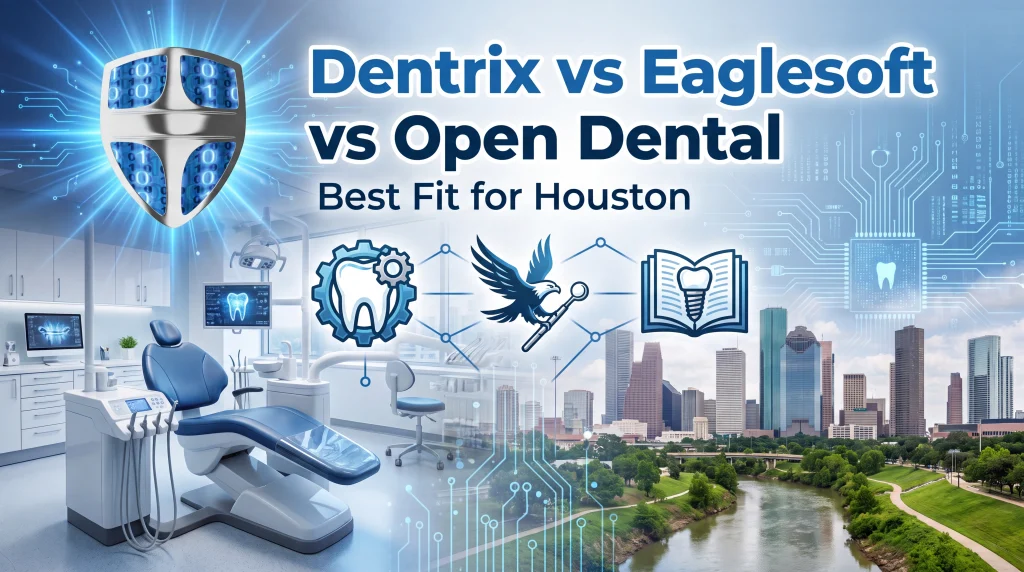
Image alt text: Dentrix vs Eaglesoft vs Open Dental comparison for Houston dentists with Dexis and Sidexis/Sirona imaging integrations
Frequently Asked Questions
Q1. Which is best for my Houston practice: Dentrix vs Eaglesoft vs Open Dental?
Short answer: It depends on your workflows, imaging stack, and reporting needs.
Details: Dentrix often suits established practices wanting an all-in-one feel with strong Dexis ties. Eaglesoft is front‑desk friendly with dependable charting and claims. Open Dental excels when you want flexibility, custom reports, and extensibility. Test with your real data, sensors, and network to see which aligns with your operatory performance and staff comfort.
Q2. How should I test Dexis or Sidexis/Sirona imaging with each platform before I choose?
Short answer: Run a pilot in a real operatory.
Details: Install drivers, confirm bridges/plugins, and capture sample images on the actual PCs, switches, and storage you’ll use. Validate launch times, image write speeds, and chart-to-imaging switching during peak hours. In Houston, also check closet cooling and workstation specs to prevent imaging lag in summer humidity.
Q3. Can we migrate to Dentrix, Eaglesoft, or Open Dental without major downtime?
Short answer: Yes, with a structured cutover.
Details: Perform data cleanup first (providers, plans, codes), stage the new environment, and snapshot the legacy system. Schedule an after-hours sync, validate logins/permissions, e-claims connectivity, and imaging capture, and keep the old system read-only for reference. See our remote helpdesk approach here: https://comptss.com/remote-helpdesk-unlocking-it-support-remote
Q4. What HIPAA-related security steps matter most across these platforms?
Short answer: Role-based access, MFA, patching, and secure email.
Details: Use unique logins, minimum‑necessary permissions, and MFA where supported. Keep servers/workstations patched, restrict admin rights, and use business‑grade email filtering and encryption for PHI. For deeper guidance, visit: https://comptss.com/hipaa-compliance-unlocking-healthcare-it-hipaa
Q5. How do Dentrix, Eaglesoft, and Open Dental differ for multi-location or multi-provider reporting?
Short answer: All support growth; Open Dental often leads on custom reporting.
Details: Dentrix and Eaglesoft offer mature e-claims, AR, and production/collection reports. Open Dental’s queries and custom reports can be advantageous for DSOs or practices tracking bonus models and multi‑location KPIs. Validate permissions, reporting, and clearinghouse workflows at scale in a pilot.
Q6. What IT infrastructure should a Houston dental office prioritize for operatory performance?
Short answer: Enterprise-grade wired networking and properly spec’d PCs.
Details: Use a wired backbone for operatories, business‑class switches/VLANs, and modern CPUs with adequate RAM/SSD and supported graphics. Keep servers in ventilated spaces and consider UPS/surge protection for storm season. Dual‑WAN/LTE failover can help in parts of Katy and Sugar Land.
Q7. How should we handle backups and disaster recovery for dental databases and imaging?
Short answer: Encrypted, automated, versioned, off‑site—and tested.
Details: Back up databases, imaging folders, and configs on a schedule that avoids clinic hours. Test restores to confirm recovery time meets expectations. Learn more: https://comptss.com/cloud-backup-unlock-it-success-cloud-backup-sys and our ransomware planning: https://comptss.com/ransomware-recovery-master-ransomware-recovery
Q8. What’s the real difference in patient communications and online booking across these systems?
Short answer: All three work with modern comms tools; integration paths vary.
Details: Dentrix and Eaglesoft often use integrated or partner add‑ons; Open Dental frequently pairs with third‑party tools for granular control. Confirm HIPAA alignment and ensure templates match your brand voice. If you need help evaluating options, see: https://comptss.com/it-solutions-revolutionize-dental-practice-it-s
Q9. What total cost areas should I plan for—beyond license fees?
Short answer: Software, add‑ons, hardware, and IT rollout/ongoing support.
Details: Plan for modules (texting, eRx, portals), imaging bridges, PCs/servers or cloud hosting, sensors/CBCT, and reliable backups. Budget time for data cleanup, training, and a hypercare period. Flat‑rate managed IT with monitoring can stabilize long‑term costs in Houston.
Q10. What first-hand lessons have you seen in Houston migrations?
Short answer: Pilot your top workflows before go‑live to catch issues early.
Details: In our Houston rollouts, teams that rehearsed two to three high‑volume front‑desk tasks and key imaging routines over a weekend typically surfaced a permissions gap or a sensor driver quirk we fixed before Monday. That small pilot consistently reduces chairside delays and go‑live stress.
Q11. Can CompTSS support any of these platforms locally in Greater Houston?
Short answer: Yes—Dentrix, Eaglesoft, and Open Dental, plus Dexis/Sidexis.
Details: We implement, secure, and support all three systems with 24/7 monitoring, rapid remote helpdesk, and on‑site visits across Houston, Katy, and Sugar Land. We’re vendor‑agnostic and can run a readiness check or pilot. Learn more: https://comptss.com/ and https://comptss.com/remote-helpdesk-unlocking-it-support-remote
Q12. How do I decide between Dentrix vs Eaglesoft vs Open Dental if my team is split?
Short answer: Let a pilot with your data and imaging decide.
Details: Score each platform on scheduling, charting, imaging speed, claims, reporting, and security controls. Weigh staff feedback from short, role‑specific trials. Pick the one that performs best in your real Houston environment and aligns with your growth and HIPAA posture.
Calm next step for Houston dentists
If you’re comparing Dentrix vs Eaglesoft vs Open Dental, start with your workflows, imaging stack, and HIPAA needs. Prioritize operatory performance, the scheduling and communications features your team will actually use, and a proven backup and recovery plan. Then test with your real data and confirm you have local support for deployment, training, and incident response.
CompTSS is a Houston-based partner that can implement, secure, and support any of these platforms. If you’d like a vendor-agnostic walkthrough, a pilot plan, or a readiness check for migration and recovery, reach out—our team is here to help you choose confidently and roll out smoothly.