Local SEO — Dental Website ADA Compliance in Houston: Simple Fixes That Improve Patient Experience
Dental Website ADA Compliance in Houston: Simple Fixes That Improve Patient Experience
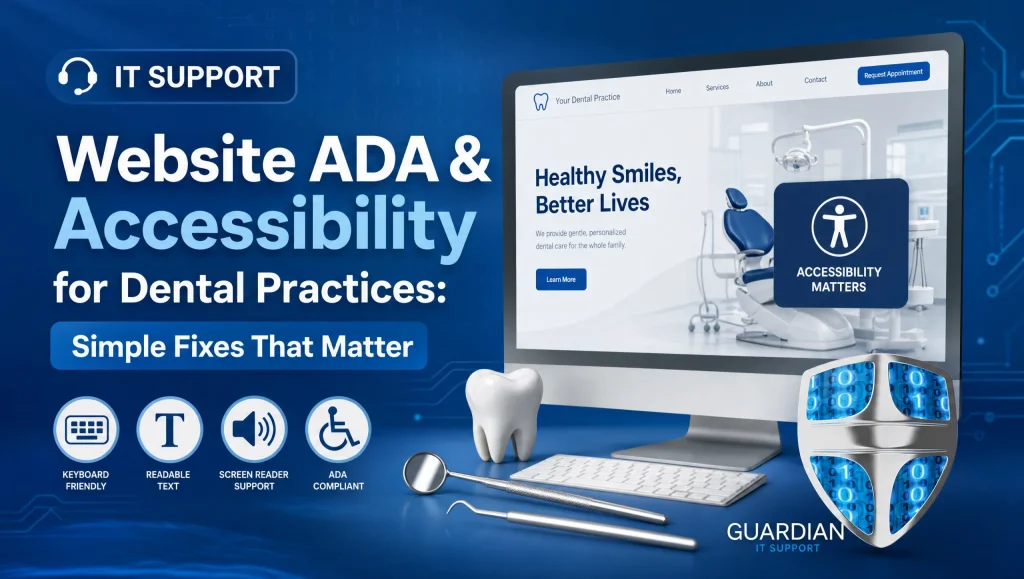
If you operate a dental practice in Houston, accessibility on your website is no longer a “nice to have”—it’s part of delivering patient-centered care and being discoverable online. Dental website ADA compliance means making your practice’s site usable for people with disabilities by following accessibility standards like WCAG. That includes readable text, keyboard‑friendly navigation, alt text for images, sufficient color contrast, accessible forms, and compatible third‑party tools—so patients can find information and book care without barriers. The payoff goes beyond inclusivity: better patient experience, stronger local SEO signals, and lower legal risk for healthcare businesses.
WCAG (Web Content Accessibility Guidelines) is the practical playbook for accessibility. While the ADA is the civil rights law, WCAG is the standard most teams use to implement accessible websites—especially important for healthcare sites that provide sensitive information and booking pathways.
Why Dental Website ADA Compliance Matters in Houston
- Patient experience and access to care
Houston is large, diverse, and always on the move. Patients juggle work, school pickups, and traffic on I‑10, I‑45, or 59. Many rely on mobile and assistive technologies such as screen readers, high‑contrast displays, or keyboard navigation. An accessible site ensures every patient—older adults, people with low vision, those recovering from oral surgery, or families navigating in Spanish and English—can quickly find hours, insurance information, parking details, and book appointments. - Local SEO and reputation benefits
Accessibility overlaps with technical and content best practices that search engines reward: clean structure, descriptive alt text, video captions, and readable content. These improve crawlability, reduce bounce rates, and help Google connect your pages with local intent—“dentist near Memorial,” “emergency dentist in Katy,” or “pediatric dentist Sugar Land.” Accessibility also builds trust when patients compare providers. - Managing legal risk without fear tactics
Accessibility can reduce the likelihood of demand letters or complaints. While this article is not legal advice, aligning with WCAG and maintaining reasonable, ongoing efforts shows good‑faith progress. Documenting fixes, keeping change logs, and testing on a set cadence further strengthens your risk posture.
WCAG for Healthcare Sites—What Houston Dentists Should Know
- Core principles: Perceivable, Operable, Understandable, Robust (POUR)
- Perceivable: Content is visible and audible (e.g., alt text and transcripts).
- Operable: Usable by keyboard and assistive tech; no traps.
- Understandable: Clear language, predictable navigation, helpful error text.
- Robust: Works with current and future browsers, devices, and assistive tools.
- Levels A, AA, AAA—what most practices aim for
Most dental sites target WCAG 2.1 AA as a practical standard. It strikes the right balance between impact and effort: adequate color contrast, keyboard access, clear labels, and accessible error handling. AAA is excellent where feasible (for example, sign language for key videos), but AA is the realistic benchmark for small and midsize practices. - Dental‑specific considerations (forms, portals, appointment booking, maps, PDFs)
Healthcare tasks such as insurance verification, medical history, pre‑op instructions, and appointment scheduling must be accessible. Forms need labels, instructions, and clear errors. Appointment portals and payment systems should be navigable by keyboard and screen reader. Maps need text alternatives for location details and transit info. PDFs (intake forms, post‑op instructions) should be tagged—or, better yet, offered in HTML.
Accessibility Checklist: Simple Fixes That Make a Big Difference
Text and structure
- Use one H1 per page, then H2/H3 in a logical order.
- Write descriptive page titles and meta descriptions.
- Use descriptive link text: “View insurance options” instead of “Click here.”
- Choose readable fonts and sizes; avoid dense, justified paragraphs.
- Keep language plain and direct; define dental jargon when needed.
Color and contrast
- Meet WCAG AA color contrast (at least 4.5:1 for body text).
- Use more than color to show meaning (e.g., underline links; use icons plus labels).
- Keep visible focus indicators (the outline when tabbing through links and buttons).
- Test your brand palette; consider an accessible “AA palette” for text and buttons.
Images and media
- Add alt text for clinical images and team photos. Example alt text: “Dental website ADA compliance—Dr. Nguyen, Houston family dentist, greeting a child patient at the front desk.”
- For before/after cases, describe the outcome (“restored front incisors with veneers”) rather than non‑specific labels.
- Caption videos and provide transcripts; avoid autoplay audio and flashing effects.
- For decorative images, use empty alt text so screen readers skip them.
Navigation and keyboard use
- Add a “Skip to main content” link for screen reader and keyboard users.
- Ensure logical tab order across menus, modals, and forms.
- Provide visible focus states on links, buttons, and form fields.
- Avoid keyboard traps in pop‑ups and third‑party widgets.
Forms and online booking
- Every field needs a programmatic label (not just placeholder text).
- Provide clear, polite error messages that explain what to fix.
- Use accessible date pickers and ensure all controls work by keyboard.
- Offer reasonable timeouts and save progress when possible.
- Clarify required vs. optional fields and provide formatting examples.
PDFs, intake forms, and patient instructions
- Offer HTML versions of critical patient forms; tag PDFs for accessibility if you keep them.
- Use large tap targets on mobile and readable line spacing.
- Keep file names clear (“post‑op‑extraction‑instructions.pdf”).
Third‑party tools
- Choose accessible vendors for patient portals, chat, maps, and schedulers; ask for their accessibility conformance details.
- Configure widgets to avoid keyboard traps, flashing, or color‑only status cues.
- Provide text alternatives for embedded maps (address, nearest intersections, transit notes, and parking guidance).
Tools to Evaluate Your Dental Website’s ADA Compliance
Automated checkers (how to use responsibly)
- Use browser‑based accessibility checkers to find common issues: missing alt text, contrast failures, and malformed headings.
- Treat these as triage, not a final verdict. Automated tools catch only a fraction of real issues.
- Re‑run checks after each update and track results in a change log.
Manual checks any team member can do
- Keyboard test: Can you fully navigate the site, forms, and portal pop‑ups using only Tab, Shift+Tab, and Enter?
- Visual scan: Is there a visible focus outline? Are links clearly distinguished from surrounding text?
- Alt text spot check: Do images on high‑traffic pages have relevant alt text?
- Content read‑through: Are headings descriptive and in order? Do links make sense out of context?
- Mobile test: Are tap targets large enough? Is zoom allowed?
When to bring in an expert accessibility review
- If you have complex booking or payment flows, PDFs for clinical instructions, or third‑party tools you don’t control, bring in an accessibility specialist to conduct a WCAG 2.1 AA audit, prioritize fixes, and advise on vendor settings.
- Consider a HIPAA‑aware partner who understands dental workflows and integrates with your existing software stack.
Common Pitfalls We See in Houston Dental Sites (and Quick Fixes)
Text in images instead of live text
- Problem: Promotions or office hours embedded in graphics.
- Quick fix: Use real text layered over images with accessible contrast, and reflect the info in plain HTML below the graphic.
Low‑contrast brand colors
- Problem: Light teal text on white or subtle gray on hero images.
- Quick fix: Keep your brand palette, but define AA‑compliant text and button shades. Offer an “accessible theme” for key UI elements.
Unlabeled icons and buttons
- Problem: Icon‑only navigation (e.g., a calendar or car icon) without labels.
- Quick fix: Add visible labels or aria‑labels so screen readers and voice control users can understand and operate controls.
PDF‑only forms without HTML alternatives
- Problem: Patients struggle to download, fill, and re‑upload on mobile.
- Quick fix: Publish HTML versions of intake and consent forms with clear steps and save/resume where possible. Keep PDFs as a secondary option.
Short myth vs. fact: Accessibility on Dental Websites
- Myth: “We installed an accessibility widget—so we’re compliant.”
Fact: Overlays can’t retrofit core issues like poor contrast, unlabeled forms, or broken keyboard flows. Focus on native fixes first. - Myth: “Accessibility ruins our design.”
Fact: With smart color tokens and component patterns, accessible design looks clean and on‑brand—and often performs better. - Myth: “Only screen reader users benefit.”
Fact: Accessible sites help everyone: faster wayfinding, clearer language, better mobile usability, and stronger SEO.
Building Accessibility into Your Website Process
Content workflows: alt text, headings, and link text standards
- Create a simple content style guide: H1/H2 usage, max sentence length, plain‑language standards, and alt text examples for clinical images.
- Require descriptive link text every time (“View Medicaid info”).
- Keep a checklist for new posts to ensure consistency across your team.
Design systems: color tokens, component patterns, focus styles
- Document AA‑compliant color tokens for text, backgrounds, and buttons.
- Standardize accessible components—nav bars, modals, accordions, and form inputs—with baked‑in focus indicators and roles/labels.
- Version‑control your design library so improvements cascade across the site.
Ongoing monitoring with backups and change logs
- Track accessibility changes, test dates, and audit results in a shared log.
- Before big updates, snapshot your site and keep recoverable versions. If you need guidance setting up encrypted backups and recovery testing, see our resource on encrypted backups and recovery testing (Unlock IT Success: Cloud Backup & System Recovery Insights Revealed: https://comptss.com/cloud-backup-unlock-it-success-cloud-backup-sys).
- For broader continuity planning and response protocols, explore business continuity for your practice website so you can restore quickly if a plugin or update breaks accessibility (Ultimate IT Support Services: Ensure Business Continuity & Optimization: https://comptss.com/it-support-services-ultimate-it-support-servi).
Local‑first examples for Houston dental practices
- Location details: Provide text directions for transit users (e.g., METRO routes) and accessible parking notes.
- Weather planning: During extreme weather or hurricane season, post accessible closure alerts and rescheduling info—avoid images with text‑only updates.
- Bilingual navigation: If you offer Spanish content, make language switching easy to find and label clearly.
A quick, copy‑paste starter checklist for your team
- Write or improve alt text on homepage, services, and team pages.
- Raise color contrast on buttons and body text to WCAG AA.
- Ensure keyboard access across menus, forms, and pop‑ups; show a visible focus outline.
- Rebuild primary forms with proper labels, helpful error messages, and accessible date pickers.
- Add captions to any homepage or services videos.
- Replace critical PDF‑only forms with HTML versions.
- Add “Skip to content” and confirm logical heading order.
- Test with one automated checker plus a 10‑minute manual keyboard run‑through.
What real improvements feel like to patients (our local experience)
In our Houston dental projects, we often see the biggest wins come from cleaning up appointment forms—adding clear labels, better error text, and improving keyboard focus. Patients tell the front desk that booking “just felt easier,” and bounce rates on the scheduler tend to drop after these tweaks. It’s a small set of changes that regularly removes real friction for busy families.
How CompTSS Helps Houston Dental Practices Get ADA‑Ready
- HIPAA‑aware web design, SEO, and maintenance
We design and maintain accessible, HIPAA‑aware websites for dental and healthcare providers in Greater Houston. That includes practical WCAG implementation, content style guides for your team, and attention to local SEO. Explore our broader services and support at Dental & Healthcare IT Support in Houston. - Integration with dental software and portals
We specialize in dental workflows and coordinate with your booking platforms and patient portals so accessibility improvements extend to the tools your patients actually use. For deeper context on regulated workflows and risk, review our take on HIPAA‑aware healthcare IT practices (Unlocking Healthcare IT: HIPAA, EHR & Cutting‑Edge System Trends: https://comptss.com/hipaa-compliance-unlocking-healthcare-it-hipaa), and see how our dental IT solutions and integrations support secure, efficient operations (Revolutionize Dental Practice: IT Solutions for Secure, Efficient Ops: https://comptss.com/it-solutions-revolutionize-dental-practice-it-s). - Flat‑rate support, 24/7 monitoring, and tested backups
Our flat‑rate Assurance plan includes responsive support with fast remote helpdesk for site issues (Unlocking IT Support: Remote Helpdesk & System Recovery Secrets: https://comptss.com/remote-helpdesk-unlocking-it-support-remote), plus around‑the‑clock monitoring. We also implement automated, encrypted backups with documented recovery tests to protect your site and content as you evolve accessibility over time (Unlock IT Success: Expert System Recovery & Cloud Backup Tips: https://comptss.com/system-recovery-unlock-it-success-expert-system).
Houston‑focused tips you can act on this week
- Update your contact and location page with text‑based directions, parking info, and elevator/entrance accessibility notes.
- Caption any intro video on your homepage and include a transcript.
- Add alt text to provider headshots and top service images. Example image alt text for upload: “Dental website ADA compliance—Dr. Alvarez, cosmetic dentist in Houston, smiling in operatory.”
- Increase contrast on your main call‑to‑action button and confirm visible focus states.
- Rebuild your appointment form with proper labels and clear, friendly error messages.
When to level up your compliance efforts
- You’ve handled the quick wins but still have complex schedulers, payments, or insurance verification steps in third‑party tools.
- You publish clinical PDFs or multilingual content and need consistent tagging and language switching.
- You want a governance plan: testing cadence, content style guide, component library, and incident response if an update breaks accessibility.
If that sounds familiar, we can help with a focused review, a prioritized roadmap, and implementation support that respects your brand and practice operations.
Conclusion: Make dental website ADA compliance a patient‑first standard
Accessibility is about people—real patients in Houston who want to book care without roadblocks. By aligning with WCAG for healthcare sites, you improve patient experience, strengthen local SEO, and reduce legal risk. Start with the simple, high‑impact fixes: alt text, color contrast, keyboard navigation, labeled forms, and HTML alternatives to PDFs. Then build accessibility into your ongoing content and design process, supported by monitoring and reliable backups.
If you’d like a practical, HIPAA‑aware review of your site and a prioritized action plan, CompTSS is here to help. Reach out for a calm, no‑pressure assessment and we’ll show you where to get quick wins now—and how to maintain accessibility as your practice grows across Houston, Katy, and Sugar Land.
Frequently Asked Questions
What is dental website ADA compliance?
Short answer:
Making your dental site usable for people with disabilities by following standards like WCAG so patients can find information and book care without barriers.
Expanded answer:
Dental website ADA compliance means applying accessibility practices—readable text, keyboard‑friendly navigation, alt text for images, sufficient color contrast, accessible forms, and compatible third‑party tools—so everyone can use your site. The ADA sets civil rights expectations, while WCAG is the practical web standard most teams use to build and maintain accessible healthcare sites.
Is ADA compliance legally required for my Houston dental website?
Short answer:
While this isn’t legal advice, accessibility supports ADA principles and reduces legal risk; most practices follow WCAG to show good‑faith effort.
Expanded answer:
The ADA prohibits discrimination and has been cited in website accessibility claims. For healthcare providers, aligning with WCAG 2.1 AA and documenting ongoing fixes (change logs, test dates) demonstrates reasonable, patient‑first effort. This can lower the chance of complaints or demand letters without resorting to fear tactics.
Which WCAG level should Houston dental practices aim for?
Short answer:
WCAG 2.1 AA is the practical target for most dental sites.
Expanded answer:
AA balances impact and effort: adequate color contrast, keyboard access, clear labels, and helpful error handling. AAA is ideal where feasible (e.g., sign language on key videos), but AA is the realistic benchmark for small and midsize practices across Houston, Katy, and Sugar Land.
What simple fixes can I implement this week?
Short answer:
Start with alt text, color contrast, keyboard navigation, labeled forms, and captions.
Expanded answer:
– Add meaningful alt text to high‑traffic images (team, services).
– Raise button/body text contrast to meet WCAG AA.
– Ensure menus/forms are keyboard accessible with visible focus outlines.
– Rebuild key forms with programmatic labels and friendly error messages.
– Caption any homepage or services videos.
– Replace critical PDF‑only forms with HTML versions.
How does accessibility improve local SEO for Houston dentists?
Short answer:
Accessible sites are easier for patients and search engines to understand, which can boost local discoverability.
Expanded answer:
Clean headings, descriptive alt text, readable content, and video captions improve crawlability and reduce bounce rates. That helps search engines connect your pages with local intent like “dentist near Memorial” or “pediatric dentist Sugar Land,” while building trust when patients compare providers.
How do I make online forms and booking accessible?
Short answer:
Use labels, clear instructions, error text, keyboard‑friendly controls, and reasonable timeouts.
Expanded answer:
Give every field a programmatic label (not just placeholder text). Provide examples and polite error messages. Ensure date pickers and buttons work by keyboard and have visible focus states. Offer save/resume if possible and clearly mark required vs. optional fields. Test the full booking flow with only Tab, Shift+Tab, and Enter.
What should I do about PDFs and patient instructions?
Short answer:
Offer HTML versions for critical content and tag any PDFs you keep.
Expanded answer:
Intake forms and post‑op instructions are easier to use in HTML, especially on mobile. If you keep PDFs, tag them for accessibility, use clear file names (e.g., post‑op‑extraction‑instructions.pdf), and ensure large tap targets. Provide text alternatives for maps and parking details alongside any embedded tools.
Do accessibility widgets or overlays make my site compliant?
Short answer:
No. They can’t fix core issues like low contrast, unlabeled forms, or broken keyboard flows.
Expanded answer:
Overlays may provide optional aids, but true dental website ADA compliance depends on native fixes: proper headings, contrast, labels, keyboard access, captions, and robust code. Focus resources on getting the fundamentals right first.
How can I test my dental website’s ADA compliance?
Short answer:
Use an automated checker for triage, then perform quick manual tests and keep a change log.
Expanded answer:
Run a browser‑based checker to spot common errors (missing alt text, contrast failures). Then do a keyboard‑only run‑through, confirm visible focus states, spot‑check alt text, and scan headings/links for clarity. Repeat after updates and document results to track progress over time.
What improvements will patients actually notice?
Short answer:
Clearer forms, easier booking, readable content, and smoother navigation—especially on mobile.
Expanded answer:
In our Houston dental projects, we’ve seen small fixes—like better error text, labeled fields, and stronger focus states—make booking “just feel easier” for busy families. Front desks often report fewer abandoned appointments after these tune‑ups, reflecting a more confident patient experience.
How do third‑party tools (schedulers, maps, portals) affect compliance?
Short answer:
They’re part of the patient journey, so choose accessible vendors and configure them carefully.
Expanded answer:
Request accessibility conformance details from vendors, enable keyboard navigation and captions, avoid keyboard traps in pop‑ups, and provide text alternatives for maps (address, nearby intersections, METRO notes, parking/elevator info). Test these tools just like your main site.
When should I bring in an expert—and how can CompTSS help?
Short answer:
If you have complex booking/payments, PDFs, or multilingual content, bring in a specialist. CompTSS offers HIPAA‑aware web design, WCAG implementation, and ongoing support in Greater Houston.
Expanded answer:
A focused WCAG 2.1 AA review can prioritize fixes and align portals and schedulers with accessibility goals. CompTSS designs and maintains accessible, HIPAA‑aware dental websites, integrates with dental software and portals, and provides flat‑rate support with tested backups. Explore our services:
– Dental & Healthcare IT Support in Houston: https://comptss.com/
– HIPAA, EHR & Healthcare IT practices: https://comptss.com/hipaa-compliance-unlocking-healthcare-it-hipaa
– Business continuity & optimization: https://comptss.com/it-support-services-ultimate-it-support-servi
– Cloud backup & recovery insights: https://comptss.com/cloud-backup-unlock-it-success-cloud-backup-sys
If you’d like a practical, HIPAA‑aware review of your site and a prioritized action plan, CompTSS is here to help. Reach out for a calm, no‑pressure assessment and we’ll show you where to get quick wins now—and how to maintain accessibility as your practice grows across Houston, Katy, and Sugar Land.