Houston Clinics: Phishing Training for Medical Offices That Actually Works
Phishing Training for Medical Offices: An Effective Guide for Small Teams in Houston
Busy Houston clinics don’t have hours to spare for lengthy trainings—but you still need a reliable, repeatable way to help your team spot and report phishing before it disrupts patient care. This guide walks small medical and dental practices through phishing training for medical offices that fits real clinic life in Greater Houston: short security awareness touchpoints, monthly simulated phishing, simple email hygiene routines anyone can follow, and policy templates you can roll out in weeks—not months.
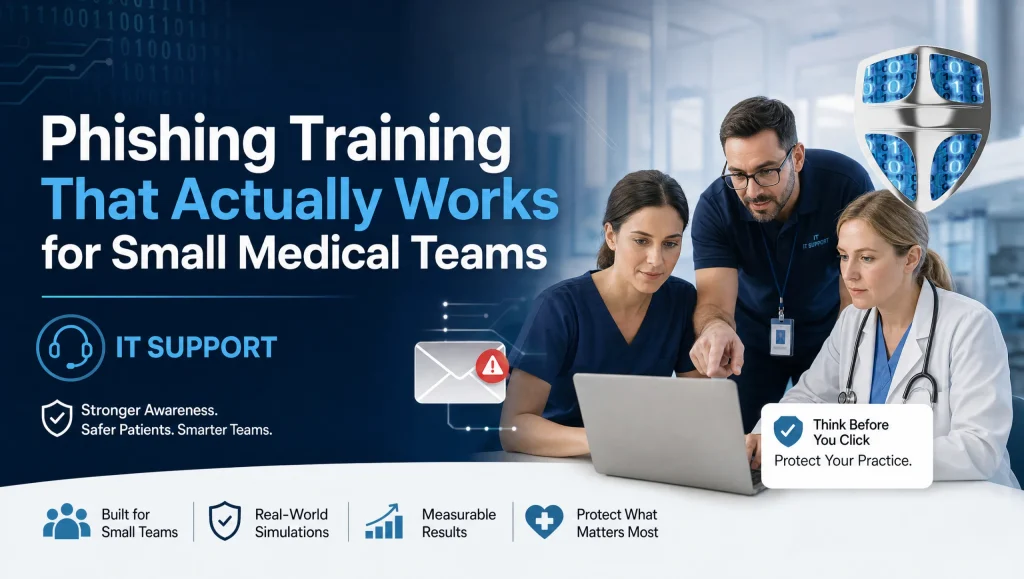
[Suggested image alt: phishing training for medical offices—Houston clinic team huddle reviewing email safety]
What Is Phishing Training for Medical Offices?
Phishing training for medical offices is a focused, healthcare‑specific security awareness program. It teaches front desk, billing, clinical staff, and providers to recognize and report malicious emails, texts, and portal messages through brief lessons, safe simulated phishing, daily email hygiene, and clear, role‑based reporting steps.
How it supports HIPAA-focused cybersecurity without disrupting care
- Reinforces minimum‑necessary access and good authentication habits without adding unnecessary steps to patient flow
- Emphasizes reporting and escalation paths that match clinic roles, so suspected incidents are contained quickly
- Aligns with risk management you’re already doing and supports audit readiness with lightweight documentation
Why Small Medical and Dental Teams Get Targeted
Attackers view clinics as high‑value, fast‑moving, and often short‑staffed. That mix makes social engineering more likely to succeed—especially during busy periods, shift changes, or when staff are multitasking.
Common attack paths: email, text, cloud portals, vendor invoices
- Email: Fake EHR alerts, HR notifications, lab results, or “secure message” prompts
- Text (smishing): “Doctor on call” urgent requests, package delivery updates, MFA code prompts
- Cloud portals: Impersonated EHR sign‑ins or file‑sharing links (imaging, billing statements)
- Vendor invoices: Spoofed statements from lab suppliers, clinical consumables, or IT vendors
The cost of a single click: downtime, data exposure, lost trust
One wrong click can lock accounts, disrupt schedules, or expose sensitive data. Even when contained fast, your team loses time to reset passwords, verify access, and reassure patients. Training that reduces clicks—and encourages quick reporting when slipups happen—protects continuity of care and patient confidence.
Core Components of an Effective Program
Security awareness micro-lessons (5–7 minutes in huddles)
- Use weekly or biweekly staff huddles you already hold
- One concise topic per touchpoint: spot a spoofed sender, hover links, verify attachments
- End with a 30‑second “what to do next” reminder: where to report and who to tell
Simulated phishing with safe, realistic scenarios
- Monthly simulations let staff practice in a consequence‑free environment
- Use familiar healthcare lures (EHR, voicemail, vendor invoices) and rotate by role
- Provide just‑in‑time coaching when someone clicks—no shaming, no public callouts
Email hygiene habits (subject scanning, link hovering, MFA prompts)
- Teach the “STOP” check (see below) to slow down and verify
- Make MFA non‑negotiable for EHR, email, billing, and backup accounts
- Normalize a shared “Report Phishing” mailbox or a “phish” button in your email client
Policy templates and role-based checklists (front desk, billing, clinical, provider)
- Include acceptable email use, reporting procedures, and vendor call‑back verification
- Create one‑page quick references by role (what to watch for, what to report, where to escalate)
- Add an incident response quick card—exactly what to do when something feels off
A 30–60–90 Day Rollout Plan That Fits Busy Clinics
First 30 days: baseline simulation, awareness kickoff, quick wins
- Run a baseline simulated phishing campaign to see current behavior
- Kick off with a 15‑minute all‑hands to connect the program to patient care and HIPAA
- Quick wins: enable MFA where missing, add a “Report Phishing” mailbox/button, and post a one‑page STOP checklist near workstations
Days 31–60: targeted drills by role, email hygiene “two-check rule,” poster prompts
- Deliver 5–7 minute micro‑lessons in huddles, one topic each week
- Introduce the “two‑check rule”: verify the sender and hover every link before clicking
- Run role‑specific simulations (front desk: appointment changes; billing: payment/refund notices; providers: EHR alerts)
- Place small poster prompts at eye level: “Pause. Hover. Verify.”
Days 61–90: policy templates finalized, quarterly tabletop incident exercise
- Finalize acceptable email use, reporting procedures, and vendor call‑back scripts
- Hold a 30‑minute tabletop once per quarter: walk through a suspected‑phish scenario and test your escalation path end‑to‑end
- Update quick‑reference cards and confirm every team member knows where to find them
Simulated Phishing That’s Safe and Meaningful
Choosing scenarios: EHR login alerts, missed voicemail, shipping updates, HR notices
- EHR login alert: “New device sign‑in detected—review activity”
- Missed voicemail: “You have 1 new voicemail from a patient—play recording”
- Shipping updates: “Sterilization supplies out for delivery—track package”
- HR notice: “Annual policy update—acknowledge to remain compliant”
What to measure: report rate, click rate, credential submit attempts
- Report rate: Your most important metric—drive this up over time
- Click rate: Aim for a steady decline without punitive measures
- Credential submits: A red‑flag metric; if it spikes, your lure or fake login page may be too convincing—rebalance for learning
Coaching, not shaming: immediate just‑in‑time education
- After a click, show a friendly training page highlighting missed red flags
- Offer a 60‑second micro‑lesson and remind staff how to report suspicious messages next time
- Keep individual results private to the person and their manager; share only team‑level trends broadly
Email Hygiene: Daily Habits That Reduce Risk
The “STOP” check: Sender, Tone, Origin, Path of links/attachments
- Sender: Does the email address match the real domain? Watch for subtle misspellings.
- Tone: Is the message unusually urgent, threatening, or secretive?
- Origin: Were you expecting it? Does it align with your normal workflow?
- Path: Hover over links—do they go where they claim? Avoid opening unsolicited attachments.
Attachment handling and password‑protected files
- Prefer secure portal sharing for PHI over email attachments
- Verify with a call‑back before opening password‑protected ZIPs or Excel files—especially if a “vendor” sends them unexpectedly
- Never bypass built‑in protections (like enabling macros) unless IT confirms safety
MFA, account alerts, and escalation paths
- Use MFA everywhere possible: email, EHR, billing, backups, remote access
- Turn on sign‑in alerts and unusual‑activity notifications
- If an account alert seems suspicious, don’t click—go directly to the known portal URL or call your IT team
Policy Templates and Quick Reference Materials
Acceptable email use, reporting procedures, vendor verification call‑backs
- Acceptable email use: Keep PHI in secure portals; limit external forwarding; use approved email for business only
- Reporting: Provide one mailbox/button for forwarding suspicious items and a backup phone number for urgent cases
- Vendor verification: Always call back using the number on file—not the number in the email—before approving account or payment changes
Role-based one‑pagers for front desk, billing, and clinicians
- Front desk: Appointment changes, patient messages, voicemail links, insurance requests
- Billing: Refund notices, bank requests, payment portal messages
- Clinicians/providers: EHR prompts, e‑prescription alerts, remote access notices
Incident response quick card for suspected phishing
- Step 1: Do not click further or reply
- Step 2: Report to the dedicated address/button
- Step 3: If you clicked or entered credentials, call IT immediately and change your password
- Step 4: Note any patient or data context to aid response
Measuring Success Without Slowing the Clinic
Monthly metrics: report rate up, risky clicks down
- Track a few simple numbers monthly: report rate, click rate, and the percentage of staff completing micro‑lessons
- Review by role so you can tune future scenarios and coaching where it matters most
Quarterly review: scenario refresh, policy updates
- Retire overused lures and introduce new, relevant ones
- Adjust policy templates based on real incidents and frontline feedback
Align with HIPAA risk management and audit readiness
- Log training dates, attendance, simulation results, and policy acknowledgments
- Keep evidence of tabletop exercises and any corrective actions
- These artifacts support ongoing risk management and help demonstrate reasonable safeguards
Houston Considerations and How CompTSS Can Help
Houston’s healthcare community runs on tight schedules and high patient volume. Our local team understands the pressure on front desk and clinical staff, and we design training to respect appointment blocks and shift changes. CompTSS provides:
- Healthcare‑specialized managed IT with 24/7 monitoring and fast remote help, plus on‑site support across Greater Houston, including Katy and Sugar Land
- HIPAA‑focused cybersecurity: risk assessments, encryption, MFA, email filtering, and patch management
- Automated, encrypted backups with tested disaster recovery
- Dental software support (Dentrix, Eaglesoft, Open Dental, Dexis, Sidexis/Sirona) and custom integrations
- Website design and SEO to build patient trust and local visibility
If you’re ready to blend culture, training, and technology, explore our dental and healthcare IT support in Houston and our HIPAA‑focused cybersecurity audit for a clear action plan:
- Visit our dental and healthcare IT support in Houston page: https://comptss.com/
- Learn about a HIPAA‑focused cybersecurity audit: https://comptss.com/cybersecurity-audit-ultimate-cybersecurity-audit
Real-World Practice Note
At a Houston dental office, we ran a month‑one baseline simulation using a “missed voicemail” lure. Staff reported messages more often than they clicked, but front‑desk shifts needed extra coaching. We added a five‑minute huddle and a vendor call‑back script; the next month, clicks fell and reporting rose—without extending check‑in times.
Myth vs. Fact: Phishing Training in Small Clinics
- Myth: “We’re too small to be targeted.” Fact: Attackers often prefer small practices because teams are busy and resources may be limited.
- Myth: “Training takes hours we don’t have.” Fact: 5–7 minute micro‑lessons during existing huddles build strong habits over time.
- Myth: “Simulated phishing hurts morale.” Fact: Coaching‑first programs improve confidence and teamwork when feedback is private and constructive.
- Myth: “We need expensive tools to start.” Fact: Begin with a basic simulation platform, a shared reporting mailbox, and simple policy templates; scale later.
Quick Start Checklist
Use these steps to launch a lightweight program this month:
- Create a shared “Report Phishing” mailbox or enable your email client’s report button.
- Post the STOP checklist near front desk, billing, and clinical workstations.
- Turn on MFA for email, EHR, billing, and backup accounts.
- Schedule one 15‑minute kickoff and add weekly 5–7 minute micro‑lessons to existing huddles.
- Run a baseline simulated phishing campaign with two healthcare‑relevant lures.
- Assign a point person per shift to triage reports and escalate to IT.
- Adopt a simple vendor call‑back script using numbers on file—not from the email.
- Document attendance and outcomes to support HIPAA risk management.
- Explore deeper guidance: healthcare IT support tips for clinics (https://comptss.com/it-tips), phishing defense and incident response, and automated, encrypted backups and recovery insights (https://comptss.com/cloud-backup-unlock-it-success-cloud-backup-sys).
- If you need hands‑on help, contact us for HIPAA‑compliant IT support for clinics: https://comptss.com/
How CompTSS Integrates Training with Broader Protection
A strong culture pairs best with tuned technology. While your team builds habits, we strengthen defenses behind the scenes:
- Email security: filtering, impersonation protection, and spoof detection configured for healthcare workflows
- Endpoint and patch management to reduce exploit risk
- Tested recovery plans so a mistake doesn’t become a disaster—see our ransomware recovery and disaster planning guide: https://comptss.com/ransomware-recovery-master-ransomware-recovery
- Fast remote helpdesk support when something feels off: https://comptss.com/remote-helpdesk-unlocking-it-support-remote
- Ongoing education tied to unlocking healthcare IT and HIPAA trends: https://comptss.com/hipaa-compliance-unlocking-healthcare-it-hipaa
Featured-Snippet Essentials at a Glance
- Definition: Phishing training for medical offices teaches staff to spot, report, and avoid malicious messages through short lessons, safe simulations, daily email hygiene, and clear reporting policies tailored to healthcare workflows.
- Key components:
- 5–7 minute security awareness micro‑lessons in huddles
- Monthly simulated phishing with healthcare‑realistic lures
- Email hygiene routines (verify sender, hover links, handle attachments safely)
- Role‑based policy templates and reporting steps
- Metrics that matter: report rate up, risky clicks down
- Quick answers:
- Train in short weekly touchpoints and run a monthly simulation
- If someone clicks, coach immediately and review reporting steps
- Start with a basic platform, shared inbox, and simple policies—scale later
- Local Houston support helps align with your workflows and provides fast on‑site help when needed
Putting It All Together
An effective program doesn’t overwhelm staff or derail appointments. With short security awareness huddles, realistic simulated phishing, everyday email hygiene, and clear policy templates, phishing training for medical offices can be both practical and powerful. If you’re a Houston‑area clinic—medical or dental—CompTSS can help you roll this out quickly, align it with HIPAA‑focused cybersecurity, and back it with resilient backups and incident response. For friendly guidance and local support, visit our dental and healthcare IT support in Houston page at https://comptss.com/ or request a HIPAA‑focused cybersecurity audit at https://comptss.com/cybersecurity-audit-ultimate-cybersecurity-audit.
Frequently Asked Questions
What is phishing training for medical offices?
Short answer: A healthcare-focused program that teaches staff to spot, report, and avoid malicious messages through short lessons, safe simulations, daily email hygiene, and clear reporting.
Expanded: Phishing training for medical offices combines 5–7 minute security awareness micro-lessons, monthly simulated phishing, simple email hygiene routines, and role-based reporting steps. It’s designed for front desk, billing, clinical staff, and providers so small Houston teams can build habits without disrupting patient care.
How long should sessions be for small Houston clinics?
Short answer: 5–7 minutes in existing huddles, plus one monthly simulation.
Expanded: Use weekly or biweekly staff huddles already on your schedule for short, focused topics (like hovering links), and run a monthly simulated phishing campaign. This cadence builds muscle memory while respecting busy appointment blocks and shift changes.
How does this support HIPAA without slowing care?
Short answer: It reinforces minimum-necessary access, clear reporting paths, and light documentation that aligns with your HIPAA risk management.
Expanded: The program emphasizes authentication best practices (like MFA), role-based escalation steps, and quick records of training, simulations, and policy acknowledgments. These artifacts support reasonable safeguards and audit readiness without adding friction to patient flow.
What should we do immediately if someone clicks a phishing email?
Short answer: Stop further action, report it, change the password if credentials were entered, and contact IT.
Expanded: Follow your incident quick card: do not reply or click more links; use your “Report Phishing” mailbox/button; if you entered credentials, call IT and reset your password right away; note any patient/data context. For fast help, CompTSS provides a responsive remote helpdesk: https://comptss.com/remote-helpdesk-unlocking-it-support-remote
What attack types do small medical and dental teams see most?
Short answer: Fake EHR alerts, voicemail or HR notices, shipping updates, texts from “doctor on call,” and spoofed vendor invoices.
Expanded: Expect lures across email, text (smishing), and cloud portals: “secure message” prompts, MFA code baits, impersonated EHR sign-ins, and vendor billing changes. Train staff to pause, hover, and verify—especially during busy periods or shift handoffs.
What should we measure to know training is working?
Short answer: Report rate up, click rate down, and credential submit attempts trending low.
Expanded: Track monthly metrics by role: the percentage of reported simulations, risky clicks, and any attempts to enter credentials on fake pages. Review quarterly to refresh scenarios, update policies, and tune coaching where it matters most.
What does a 30–60–90 day rollout look like?
Short answer: Baseline now, huddle lessons and role-based drills next, finalize policies and run a tabletop by day 90.
Expanded: First 30 days: baseline simulation, 15‑minute kickoff, enable MFA, add a “Report Phishing” button, and post STOP checklists. Days 31–60: weekly 5–7 minute lessons, “two-check rule,” role-specific simulations, and posters. Days 61–90: finalize policies and scripts, run a 30‑minute tabletop, and update quick-reference cards.
Do we need expensive tools to start phishing training for medical offices?
Short answer: No—start with a basic platform, a shared reporting mailbox, and simple policy templates.
Expanded: Phase in advanced tools later. Early wins come from monthly simulations, STOP checklists at workstations, MFA across critical systems, and a clear escalation path. For templates and practical tips, see: https://comptss.com/it-tips
How often should we run simulated phishing, and which lures work best?
Short answer: Monthly, using realistic healthcare scenarios.
Expanded: Rotate lures by role: EHR login alerts for clinicians, appointment changes for front desk, payment/refund notices for billing, and HR updates for all. Keep it coaching-first: immediate, private feedback after clicks builds confidence.
How do backups and recovery fit into phishing defense?
Short answer: Tested, encrypted backups turn mistakes into recoverable events.
Expanded: Even with strong habits, accidents happen. Automated, encrypted backups with tested disaster recovery help you restore quickly and protect continuity of care. Learn more: https://comptss.com/cloud-backup-unlock-it-success-cloud-backup-sys and ransomware/disaster planning: https://comptss.com/ransomware-recovery-master-ransomware-recovery
How can CompTSS help Houston-area clinics implement this quickly?
Short answer: We tailor training to your workflows and back it with HIPAA-focused cybersecurity, 24/7 monitoring, and fast support.
Expanded: CompTSS designs right-sized programs for Greater Houston practices—micro-lessons, simulations, policy templates, email security, MFA, patching, and tested recovery. Start here: dental and healthcare IT support in Houston: https://comptss.com/ and HIPAA-focused cybersecurity audit: https://comptss.com/cybersecurity-audit-ultimate-cybersecurity-audit
Real-world practice note (from the field)
Short answer: Short huddles plus a call-back script cut clicks without slowing check-ins.
Expanded: In a Houston dental office, a “missed voicemail” baseline showed front-desk shifts needed extra support. We added a five-minute huddle and vendor call-back script; clicks fell and reports rose the next month—without extending patient check-ins.