Dental Office Downtime Cost: Houston Dentist’s Practical Guide
Dental Office Downtime Cost: A Practical Guide for Houston Dentists
Houston dentists know how a small tech hiccup can ripple through a packed schedule. A quick power dip during a summer storm, a flaky switch in the imaging room, or an ISP outage can stall check-in, imaging, and charting in minutes. Quantifying dental office downtime cost gives you a clear, defensible way to prioritize business continuity—so you can decide when managed IT, backups, and cybersecurity are worth it and what “good enough” looks like for your practice in Greater Houston.
What Is Dental Office Downtime Cost?
Dental office downtime cost is the total financial impact when clinical or front-desk systems are unavailable. That includes lost appointments, staff idle time, catch-up labor, recovery work, and potential patient churn. For Houston practices, estimating this cost helps you size prevention, communicate risk to partners and staff, and choose practical safeguards before hurricane season or the next ISP maintenance window.
A Simple, Repeatable Formula for Dentists
Core variables
List these inputs once—then reuse your sheet for quick, consistent estimates:
- Scheduled patients per hour and procedure mix (hygiene vs. restorative)
- Average revenue per patient (consider hygiene vs. restorative blocks)
- Number of active operatories affected (clinical and hygiene)
- Staff hourly cost (clinical, hygiene, front desk, providers)
- Outage duration and timing (peak hours vs. lunch or late afternoon)
- Imaging/software dependency (Dexis, Sidexis/Sirona, Dentrix, Eaglesoft, Open Dental)
- Rework/catch-up factor (overtime, callbacks, reimaging, re-charting)
- Recovery/admin time after systems return (billing, claims cleanup)
- Qualitative patient impact (reputation, refunds/discounts you choose to offer)
The base equation (illustrative)
Use this quick-estimate model. Start conservatively, then refine with real data.
Downtime Cost ≈
– Direct Lost Revenue (Scheduled Patients per Hour × Average Revenue × Outage Hours × % Operatories Affected)
+ Staff Idle Cost (Sum of Hourly Staff Costs × Outage Hours × % Staff Impacted)
+ Rework/Overtime (Hours to catch up × Loaded Hourly Rate)
+ Recovery/Admin (Billing clean-up, reimaging, claim notes × Hourly Rate)
+ Qualitative Patient Impact (optional note for refunds/discounts/reputation)
Notes:
– If your front desk can still answer phones but can’t access scheduling, reduce the “% Staff Impacted” to reflect partial productivity.
– If hygiene can proceed without imaging but restorative cannot, split your estimate across procedure types.
Build Your IT Outage Calculator Sheet
Create a simple worksheet (columns for input, notes, and formula):
1) Enter your schedule mix
- Hygiene: patients/hour, average revenue, operatories affected
- Restorative: procedures/hour (or per block), average revenue, operatories affected
2) Enter staffing costs
- Hourly rates or blended hourly cost for front desk, assistants, hygienists, dentists (round numbers you’re comfortable with are fine)
3) Enter outage details
- Start/stop time (in hours), peak or off-peak
- Which systems failed: imaging, EHR, practice management, phones/VoIP, payment terminals
4) Apply the base equation
- Lost Revenue per category (hygiene, restorative)
- Staff Idle Cost for affected teams (front desk often partially impacted if phones work)
- Rework (callbacks, reimaging) and Recovery (claims resubmission, chart reconciliation)
5) Adjust for real-world nuance
- Hygiene can sometimes continue with paper notes if imaging isn’t needed—reduce Lost Revenue and increase Recovery/Admin.
- If payment terminals are down but care continues, shift some “lost revenue” to “delayed cash flow” and “extra admin.”
6) Save scenarios
- Keep one tab for a 1-hour outage, another for a half-day outage, and one for a multi-location cloud outage so you can communicate risk and set priorities quickly.
Example Scenarios for Houston Practices (Illustrative Only)
The numbers below are round figures to show the math—not recommendations or averages. Replace placeholders with your actual data.
Solo practice, 3 operatories, brief EHR/imaging outage
- Context: 1-hour outage at 9:00 a.m.; imaging (Dexis or Sidexis/Sirona) and EHR inaccessible; phones work.
- Schedule: Hygiene 1 patient/hour at $150; Restorative 1 procedure block/hour at $900; 2 operatories affected (1 restorative, 1 hygiene).
- Staff: Dentist $200/hr, Hygienist $50/hr, Assistant $30/hr, Front desk $25/hr.
Estimate:
– Lost Revenue: Hygiene ($150 × 1 hr × 1 op) + Restorative ($900 × 1 hr × 1 op) = $1,050
– Staff Idle: Dentist ($200 × 1 hr × 1) + Hygienist ($50 × 1 hr × 1) + Assistant ($30 × 1 hr × 1); front desk takes calls, so count 0.5 hr at $25 = $12.50
Total Staff Idle ≈ $200 + $50 + $30 + $12.50 = $292.50
– Rework/Overtime: Callbacks/rescheduling 0.5 hr front desk ($12.50) + re-charting once EHR returns 0.5 hr hygienist ($25) = $37.50
– Recovery/Admin: Claims cleanup and note adjustments 0.5 hr front desk ($12.50)
– Total (illustrative): $1,050 + $292.50 + $37.50 + $12.50 ≈ $1,392.50
Group practice, 8 operatories, network switch failure mid-day
- Context: 2-hour outage at 10:30 a.m.; imaging and practice management offline; VoIP phones also affected in some rooms. Four clinical operatories and two hygiene ops go dark; others limp along on paper.
- Schedule placeholder: Hygiene 2 patients/hour total across 2 ops at $150; Restorative 2 blocks/hour across 2 ops at $900.
- Staff (blended for simplicity): 2 dentists at $200/hr each, 2 hygienists at $50/hr each, 3 assistants at $30/hr, 2 front desk at $25/hr.
Estimate:
– Lost Revenue: Hygiene ($150 × 2 patients/hr × 2 hrs) + Restorative ($900 × 2 blocks/hr × 2 hrs) = ($600) + ($3,600) = $4,200
– Staff Idle: 2 dentists (2 × $200 × 2) = $800; 2 hygienists (2 × $50 × 2) = $200; 3 assistants (3 × $30 × 2) = $180; front desk partially productive (50% for 2 hrs): 2 × $25 × 1 = $50
Total Staff Idle ≈ $1,230
– Rework/Overtime: Callbacks/risk notes/reimaging 3 hrs total mixed staff time at blended $40/hr = $120
– Recovery/Admin: Billing/claims cleanup 2 hrs front desk at $25/hr = $50
– Total (illustrative): $4,200 + $1,230 + $120 + $50 ≈ $5,600
Multi-location practice, cloud outage impacting scheduling/check-in
- Context: Cloud practice management down for 3 hours across two Houston locations; clinical care continues for restorative blocks with local imaging, but check-in and payments are delayed; rescheduling churn occurs.
- Assumption: 30% of scheduled hygiene lost, restorative proceeds with paper notes; delayed payments create extra back-office work.
- Illustrative tally:
- Lost Revenue: Hygiene only—estimate your hourly hygiene revenue × 30% × 3 hrs across affected ops
- Staff Idle: Front desk largely idle; clinicians less impacted—apply partial percentages
- Rework/Overtime: 1–2 hours per location for callbacks, payment reconciliation
- Recovery/Admin: Claims resubmission and audit notes after the fact
- Total (illustrative): Run the sheet per location, then roll up the numbers
Note: These examples show how to structure your math. Substitute your actual hourly production, number of operatories, and staff costs to get a number you can trust.
What Drives Lost Appointments and Extra Costs?
Practice mix (hygiene vs. high-value procedures)
- Hygiene downtime adds up through volume; restorative downtime spikes per hour.
- Split your calculator by category so hygiene can continue on paper when it’s safe and appropriate, while restorative waits for imaging or planning software.
Imaging dependencies (Dexis, Sidexis/Sirona) and dental software (Dentrix, Eaglesoft, Open Dental)
- If imaging (Dexis, Sidexis/Sirona) is down, many restorative procedures pause. If practice management (Dentrix, Eaglesoft, Open Dental) is down, you can often continue limited care with paper notes, then add Recovery/Admin for re-entry and claims work.
Check-in/payment workflows and phone/VoIP reliance
- If VoIP or internet fails, your ability to confirm, route calls, or accept card payments may drop even when chairside care can continue. Add “delayed cash flow” notes and plan for manual receipts and batch entries later.
Compliance and data integrity considerations (HIPAA)
- Paper workarounds must still respect minimum-necessary access and privacy.
- Document your exceptions and cleanly reconcile records when systems return. See HIPAA Security Rule guidance from HHS.
Myth vs. Fact: “Short outages don’t matter.”
- Myth: A 30-minute blip is a rounding error.
- Fact: Even brief outages cause lost appointments, rework, and staff idle time—and they often create cascading schedule delays the rest of the day. Small, frequent blips may cost more annually than a single long outage. Your worksheet will show it.
Business Continuity for Dentists: Reduce the Risk and the Bill
Managed IT support with 24/7 monitoring
- Continuous monitoring catches failing disks, noisy switches, and backup errors early. Defined response playbooks shorten time-to-resolution so more visits stay on the books.
- Learn how our managed IT support for dental practices in Houston aligns tools and response with your schedule and systems: HIPAA-compliant dental IT support in Houston.
HIPAA-focused cybersecurity: MFA, patching, email filtering, risk assessments
- Many outages trace back to preventable issues: unpatched servers, weak credentials, or email-borne threats. Multifactor authentication, timely patching, and strong filtering reduce the chance an attack sidelines your practice.
- If you want a structured review, see our HIPAA-focused cybersecurity audit with Zero Trust and endpoint protection for dentists: https://comptss.com/cybersecurity-audit-ultimate-cybersecurity-audit
Automated, encrypted backups with tested disaster recovery and RTO/RPO planning
- Backups you can’t restore aren’t backups. Define recovery time objective (RTO) and recovery point objective (RPO) for EHR, imaging, and file shares—then test.
- Explore cloud backup and system recovery and build a tested disaster recovery routine.
Network and power resilience: redundant internet, UPS for servers/switches
- Dual internet (different carriers or 5G failover), a properly sized UPS for switches and servers, and segmented VLANs for imaging can keep chairs moving when one component fails.
- Consider pre-staged spares for critical switches and a written failover checklist your front desk can follow.
Remote helpdesk and on-site support for Houston, Katy, and Sugar Land
- Rapid remote triage keeps issues from spiraling. When hardware fails, local boots on the ground matter.
- For fast assistance, see our remote helpdesk for dental practices and system recovery support.
A Quick Houston Reality Check (First-Hand Perspective)
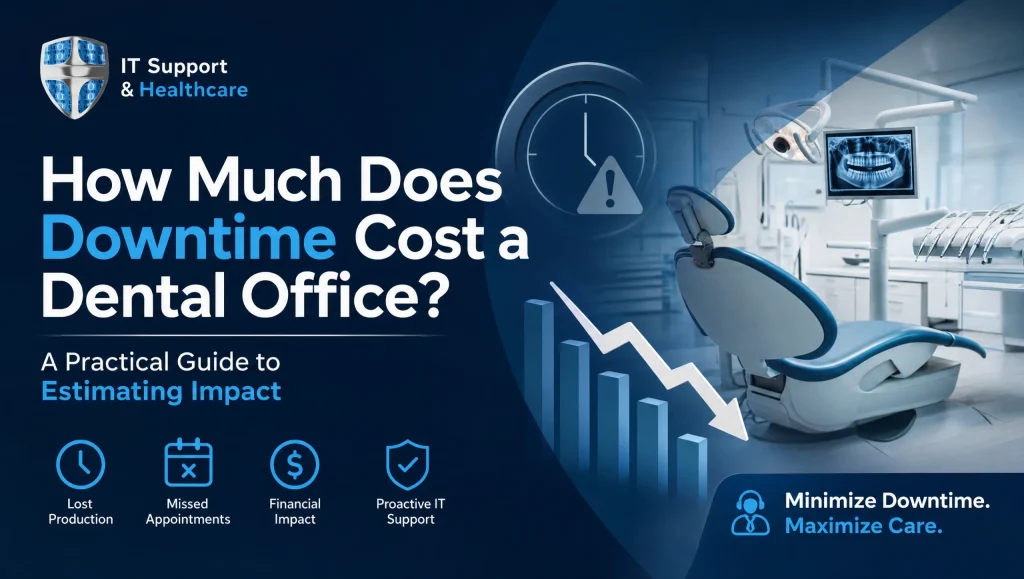
On our Houston support rounds, we’ve seen how a single failed switch can stall imaging and check-in across multiple operatories. In one case, a pre-staged spare and backup internet kept a practice seeing patients while we swapped hardware in under an hour. The takeaway we share with teams: a small kit of spares and a simple failover plan often pays for itself the first time you need it.
How CompTSS Helps You Lower Downtime Cost
Dental software support (Dentrix, Eaglesoft, Open Dental, Dexis, Sidexis/Sirona)
- We work daily in the tools that keep dental production flowing. That means faster resolution, fewer finger-pointing loops with vendors, and smoother updates aligned to your schedule.
Flat-rate Assurance plan with scalable workstation add-ons
- Predictable costs help you budget. Add workstations as you grow without unpredictable spikes, while maintaining security controls and backup coverage.
Local response: fast remote triage, on-site as needed in Greater Houston
- Our team is based in Houston and serves Greater Houston—including Katy and Sugar Land—so you get the combination of fast remote help and timely on-site support when a hands-on fix is the fastest path back to production.
Where to Go Next
- If ransomware or malware is part of your risk calculus, review ransomware recovery planning and incident response for dental offices: https://comptss.com/ransomware-recovery-master-ransomware-recovery
- For ongoing best practices, scan our healthcare IT support tips and dental IT best practices: https://comptss.com/it-tips
- For HIPAA and EHR context, see healthcare IT trends for clinics: https://comptss.com/hipaa-compliance-unlocking-healthcare-it-hipaa
How to Use This Guide With Your Team
- Run your numbers: Fill in your actual hourly production and staffing costs. Save a 1-hour, half-day, and full-day scenario.
- Prioritize mitigations: Rank the top three drivers of your dental office downtime cost—e.g., single ISP, aging switch stack, or untested backups.
- Assign owners and timelines: Who calls the ISP? Who swaps the spare switch? Who runs the backup restore test each quarter?
- Rehearse: A 30-minute tabletop walk-through every six months pays off during the real thing.
Building Your IT Outage Calculator: Field-Tested Tips
- Keep inputs simple: Two columns for hygiene and restorative are enough for most practices. Add a third column for “front desk only” if payments/scheduling are the usual bottleneck.
- Separate lost revenue from delayed revenue: If you still provide care but can’t take payments, label it “delayed cash flow” and add Recovery/Admin for reconciliation.
- Note partial productivity: If one operatory can keep working, lower the “% operatories affected” rather than assuming a total stop.
- Include timing: A 2-hour outage at 8:00 a.m. can disrupt the whole day differently than 2 hours at 3:00 p.m. Keep both scenarios saved.
Houston-Specific Pointers You Can Act On This Month
- Redundant internet: Price a second ISP or a 5G failover for your front desk and imaging VLANs.
- UPS check: Verify runtime on your UPS units for servers and switches; replace batteries before storm season.
- Spare kit: Keep one tested spare switch and key cables labeled in a small box near your rack.
- Update windows: Coordinate Dentrix/Eaglesoft/Open Dental updates outside peak hours; note vendor support contacts in your playbook.
- Backup test: Perform one file restore and one imaging restore to confirm RTO/RPO targets before hurricane season.
Alt text suggestion for hero image
- Dental office downtime cost calculator for Houston dentists — estimate lost appointments and recovery time
Bringing It All Together
When you quantify dental office downtime cost, you take the guesswork out of technology risk. A straightforward IT outage calculator—grounded in your schedule, operatories, and staffing—reveals what a one-hour, two-hour, or half-day disruption really costs. With that number in hand, it’s easier to right-size safeguards: managed IT support, HIPAA-focused cybersecurity, automated, encrypted backups with tested disaster recovery, and network resilience that fits Houston realities.
Frequently Asked Questions
What is dental office downtime cost?
Short answer: It’s the total financial impact when clinical or front‑desk systems are unavailable.
Expanded: Dental office downtime cost includes lost appointments, staff idle time, catch‑up and recovery work (like reimaging, re‑charting, and claim cleanup), and potential patient churn. Quantifying it helps Houston practices prioritize business continuity investments before storms, ISP maintenance, or equipment failures.
How do I calculate dental office downtime cost?
Short answer: Use a simple worksheet with your schedule, staffing, outage details, and the base equation.
Expanded: Start with the article’s base equation: Lost Revenue + Staff Idle Cost + Rework/Overtime + Recovery/Admin (+ optional patient impact). Enter hygiene and restorative production per hour, operatories affected, staff hourly costs, outage duration/timing, and software dependencies (Dexis, Sidexis/Sirona, Dentrix, Eaglesoft, Open Dental). Save scenarios for a 1‑hour, half‑day, and multi‑location outage so you can act fast.
Which variables influence the cost the most?
Short answer: Procedure mix, imaging/software dependency, outage timing, and how many operatories and staff are affected.
Expanded: Hygiene vs. restorative production, whether imaging (Dexis, Sidexis/Sirona) or practice management (Dentrix, Eaglesoft, Open Dental) is down, peak vs. off‑peak hours, and partial productivity (phones up, one op still running) can shift your numbers dramatically. Split calculations by procedure type and note partial impacts to stay accurate.
Do short outages really matter?
Short answer: Yes—brief blips still cause lost appointments, idle time, and rework.
Expanded: A 30‑minute interruption can trigger same‑day schedule ripple effects, callbacks, and claims cleanup. Small, frequent incidents often add up to more annual cost than one long event. Your worksheet will reveal this when you include rework and recovery time, not just immediate lost production.
How do I separate lost revenue from delayed revenue?
Short answer: Label care you still deliver without payment as delayed cash flow and add admin time for reconciliation.
Expanded: If you provide treatment but payment terminals or practice management are down, don’t call it “lost revenue.” Mark it as “delayed cash flow” and increase Recovery/Admin to cover batch entries, reconciliation, and claim notes once systems return. This keeps your estimate realistic and defensible.
What steps can reduce dental office downtime cost for Houston practices?
Short answer: Managed IT, HIPAA‑focused cybersecurity, tested backups, network/power resilience, and a remote helpdesk.
Expanded: Practical moves include 24/7 monitoring, MFA and patching, encrypted backups with tested RTO/RPO, dual internet or 5G failover, UPS for switches/servers, and a pre‑staged spare switch. For help, see HIPAA‑compliant dental IT support from CompTSS: https://comptss.com/ — plus our cybersecurity audit: https://comptss.com/cybersecurity-audit-ultimate-cybersecurity-audit — cloud backup and recovery: https://comptss.com/cloud-backup-unlock-it-success-cloud-backup-sys — and remote helpdesk: https://comptss.com/remote-helpdesk-unlocking-it-support-remote
How often should we test backups and rehearse our plan?
Short answer: Test restores regularly and run a brief tabletop drill about twice a year.
Expanded: Define RTO/RPO for EHR, imaging, and files, then prove it with restore tests. Run a 30‑minute tabletop every six months to practice who calls the ISP, who swaps a spare switch, and who handles manual receipts and later reconciliation. Save results and update your checklist.
What about HIPAA when we use paper during an outage?
Short answer: Apply minimum‑necessary access, protect PHI, and reconcile cleanly when systems return.
Expanded: Even in downtime, follow HIPAA: limit exposure of PHI, store paper securely, and document exceptions. When systems are back, enter data accurately, add claim notes, and file paper securely or destroy per policy. Include this in your written downtime playbook.
Which dental software and imaging systems should be in my plan?
Short answer: Include Dentrix, Eaglesoft, Open Dental, and imaging like Dexis and Sidexis/Sirona.
Expanded: If imaging is down, many restorative procedures pause; if practice management is down, limited care may continue on paper with added Recovery/Admin later. Map dependencies per operatory, note vendor contacts, and schedule updates off‑peak. CompTSS supports these platforms daily, helping reduce finger‑pointing and downtime.
Do I really need redundant internet and UPS in Houston?
Short answer: Yes—storms and ISP hiccups make failover and clean power essential.
Expanded: Dual internet (different carriers or 5G failover) keeps phones, check‑in, and imaging connected. A properly sized UPS for switches and servers prevents sudden shutdowns and corrupt data during power dips. Add segmented VLANs for imaging and keep a tested spare switch near your rack.
What does a 1‑hour outage typically cost a Houston dental office?
Short answer: It varies—use your own numbers for a credible estimate.
Expanded: Costs depend on your hygiene/restorative mix, operatories affected, and staff rates. The article’s examples show the math structure; plug your hourly production, staff costs, and outage timing into the worksheet to get a number you can stand behind. If you want help, our team can share a template and review it with you: https://comptss.com/
First‑hand perspective
Short answer: We’ve seen a pre‑staged spare and backup internet keep patient care moving while a failed switch was swapped in under an hour.
Expanded: On Houston service rounds, a single switch failure knocked out imaging and check‑in for multiple ops. Because the practice had a small spare‑parts kit and 5G failover, the front desk stayed reachable and restorative blocks resumed quickly. A modest resilience plan turned a potential lost morning into a short delay.
Bringing It All Together
If you’d like a calm, no-pressure review tailored to your practice, CompTSS can help. Request a short continuity review and a copy of our downtime cost calculator template. We’ll align your targets with your workflow, so the next blip is a blip—and not a blown day of production.